

A Talk on New Technique for Character Identification based on the Concepts of Chipless RFID Tags and the use of Signal Processing Algorithms


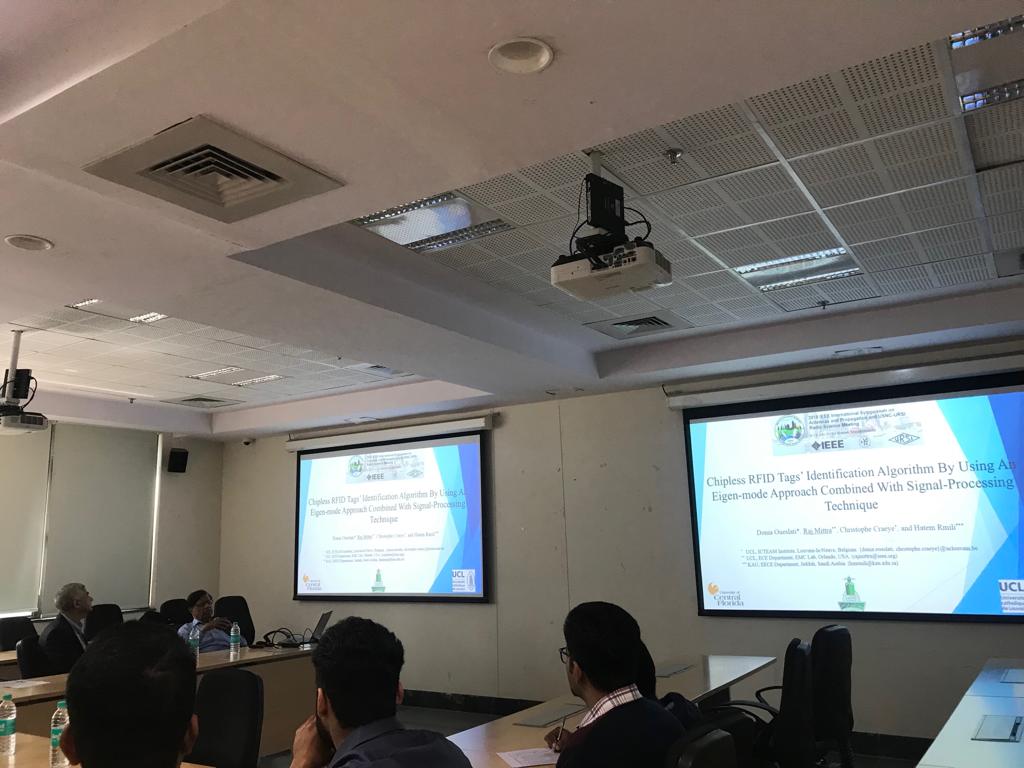
this talk described a technique for radio frequency identification of characters, such
as Latin or Arabic alphabets. The proposed technique is based on the concepts of chipless RFID
technology, which provide great advantages in terms of reliability of recognition as well as cost. We
present the design of an apparatus which consists of a plurality of transmit and receive antennas for
interrogating the characters. A special excitation scheme for the transmit antenna is developed to
enhance the performance of the recognition scheme. Next, a signal processing algorithm is
described, which processes the outputs of the receive antennas in the recognition apparatus to
discriminate the tags from each other. The algorithm is robust and is shown to work even in the
presence of some (low level) background noise in the measurement system, which is inherently
present in a practical scenario.
Date and Time
Location
Hosts
Registration
-
 Add Event to Calendar


- Indian Institute of Technology Delhi
- Hauz Khas
- New Delhi, Delhi
- India 110016
- Building: Lecture Hall Complex
- Room Number: 212
- Contact Event Host
-
Organized by: IEEE MTT-S SBC IIT Delhi in Association with IEEE MTT-S, Delhi Section.
Contacts: Dr. Mahesh P. Abegaonkar (mpjosh@care.iitd.ac.in) and Mr. Shakti Singh Chauhan (shakti.uit@gmail.com) - Co-sponsored by MTTs Delhi section
Speakers
 Prof. Raj Mittra of Penn State university
New Technique for Character Identification based on the Concepts of Chipless RFID Tags and the use of Signal Processing
In this talk we describe a technique for radio frequency identification of characters, such
as Latin or Arabic alphabets. The proposed technique is based on the concepts of chipless RFID
technology, which provide great advantages in terms of reliability of recognition as well as cost. We
present the design of an apparatus which consists of a plurality of transmit and receive antennas for
interrogating the characters. A special excitation scheme for the transmit antenna is developed to
enhance the performance of the recognition scheme. Next, a signal processing algorithm is
described, which processes the outputs of the receive antennas in the recognition apparatus to
discriminate the tags from each other. The algorithm is robust and is shown to work even in the
presence of some (low level) background noise in the measurement system, which is inherently
present in a practical scenario.
In contrast to previous works on character recognition, the proposed technique does not employ
modal analysis to design the transmit antenna excitation scheme, but designs a new excitation
scheme instead, which plays a key role in the system proposed herein. Additionally, in contrast to the
existing methods, the proposed approach utilizes a novel signal processing algorithm to achieve
improved performance in terms of the reliability of character recognition. Numerous examples will be
included in the presentation to illustrate the application of the proposed approach.
Biography:
Raj Mittra (LF’96) was a Professor of electrical and
computer engineering, Penn State, State College, PA, USA, from 1996 to
2015. He was a Professor with the Electrical and Computer Engineering,
University of Illinois at Urbana–Champaign, Champaign, IL, USA, from
1957 to 1996. He is currently a Professor with the Department of
Electrical Engineering and Computer Science, University of Central
Florida, Orlando, FL, USA, where he is currently the Director with the
Electromagnetic Communication Laboratory. He is currently the Hi-Ci
Professor with King Abdulaziz University, Jeddah, Saudi Arabia. He was
a recipient of the Guggenheim Fellowship Award in 1965, the IEEE
Centennial Medal in 1984, the IEEE Millennium medal in 2000, the
IEEE/AP-S Distinguished Achievement Award in 2002, the Chen-To
Tai Education Award in 2004 and the IEEE Electromagnetics Award in
2006, and the IEEE James H. Mulligan Award in 2011.
Address:electrical and computer engineering, Penn State University