

IEEE Signal Processing Society Distinguished Lecture


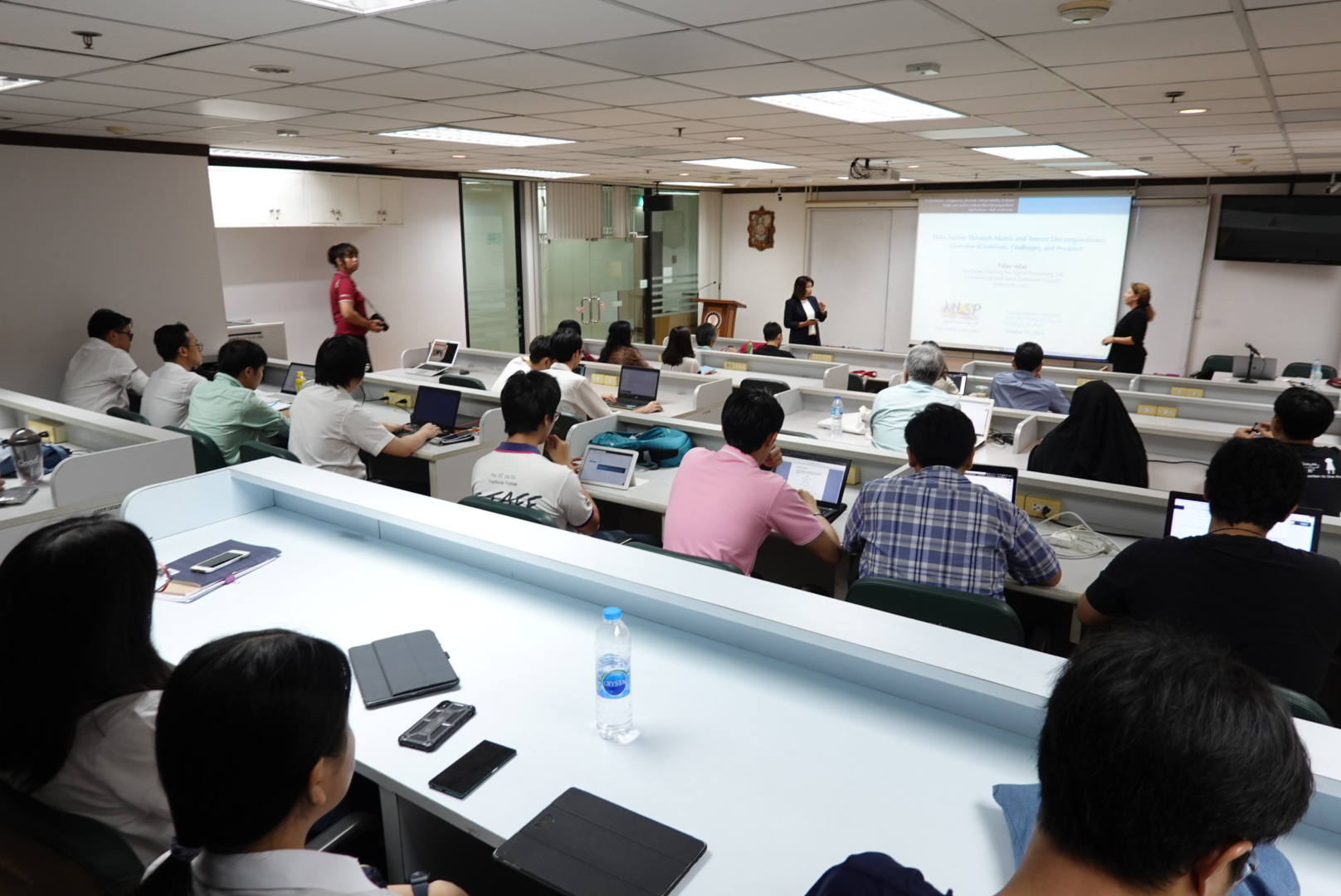
Data Fusion Through Matrix and Tensor Decompositions:
An Overview of Solutions, Challenges, and Prospects
Matrix and tensor factorizations enable joint analysis, i.e., fusion, of these multiple datasets such that they can fully
interact and inform each other while also minimizing the assumptions placed on their inherent relationships.
Examples are presented to demonstrate their effectiveness, and the main challenges and the opportunities
Date and Time
Location
Hosts
Registration
-
 Add Event to Calendar


- Department of Electrical EngineeringChulalongkorn Unilversity254 Phayathai RoadBangkok 10330 Thailand
- Bangkok, Bangkok Metropolis
- Thailand 10330
- Contact Event Host
- Co-sponsored by Chulalongkorn University
Speakers
Tulay Adali of UMBC
Data Fusion Through Matrix and Tensor Decompositions: An Overview of Solutions, Challenges, and Prospects
Matrix and tensor factorizations enable joint analysis, i.e., fusion, of these multiple datasets such that they can fully
interact and inform each other while also minimizing the assumptions placed on their inherent relationships.
Examples are presented to demonstrate their effectiveness, and the main challenges and the opportunities
Biography:
Tülay Adali received the Ph.D. degree in Electrical Engineering from North Carolina State University, Raleigh, NC, USA, in 1992 and joined the faculty at the University of Maryland Baltimore County (UMBC), Baltimore, MD, the same year. She is currently a Distinguished University Professor in the Department of Computer Science and Electrical Engineering at UMBC.
She has been active in conference and workshop organizations. She was the general or technical co-chair of the IEEE Machine Learning for Signal Processing (MLSP) and Neural Networks for Signal Processing Workshops 2001−2008, and helped organize a number of conferences including the IEEE International Conference on Acoustics, Speech, and Signal Processing (ICASSP). She has served or currently serving on numerous editorial boards and technical committees of the IEEE Signal Processing Society. She was the chair of the technical committee on MLSP, 2003−2005 and 2011−2013, the Technical Program Co-Chair for ICASSP 2017, Special Sessions Chair for ICASSP 2018. She is currently serving as the Vice President for Technical Directions of the IEEE Signal Processing Society. Prof. Adali is a Fellow of the IEEE and the AIMBE, a Fulbright Scholar, and an IEEE Signal Processing Society Distinguished Lecturer. She was the recipient of a 2010 IEEE Signal Processing Society Best Paper Award, 2013 University System of Maryland Regents' Award for Research, and an NSF CAREER Award. Her current research interests are in the areas of statistical signal processing, machine learning, and their applications with emphasis on applications in medical image analysis and fusion.
Address:University of Maryland Baltimore County (UMBC), Baltimore, , United States