

A MULTI-SCALE OPTIMIZATION FRAMEWORK FOR INTEGRATED POWER AND THERMAL MANAGEMENT


Thermal and power systems are tightly coupled and dynamically integrated. The different time scales in thermal and power responses make the integrated thermal and power management problems intriguing and challenging. For connected and automated vehicles (CAVs), the availability of predictive traffic information and the ability to coordinate multiple control subsystems allow us to explore the thermal-power interactions in new dimensions to enhance safety and improve fuel economy. It presents a perfect example where prediction, estimation, control, and optimization serve as the cornerstones for technology breakthroughs in the interconnected and dynamic environment. The talk will discuss the problems, explore the effective tools, and showcase some illustrative solutions.
Date and Time
Location
Hosts
Registration
-
 Add Event to Calendar


Loading virtual attendance info...
- Starts 15 May 2023 04:49 PM UTC
- Ends 27 July 2023 11:00 PM UTC
- No Admission Charge
Speakers
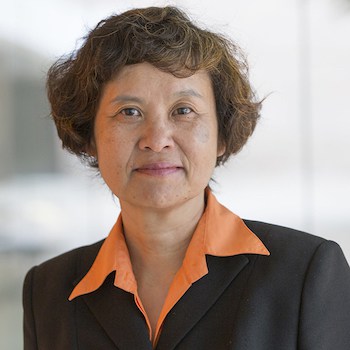 Jing of University of Michigan, ANN ARBOR
A MULTI-SCALE OPTIMIZATION FRAMEWORK FOR INTEGRATED POWER AND THERMAL MANAGEMENT
Thermal and power systems are tightly coupled and dynamically integrated. The different time scales in thermal and power responses make the integrated thermal and power management problems intriguing and challenging. For connected and automated vehicles (CAVs), the availability of predictive traffic information and the ability to coordinate multiple control subsystems allow us to explore the thermal-power interactions in new dimensions to enhance safety and improve fuel economy. It presents a perfect example where prediction, estimation, control, and optimization serve as the cornerstones for technology breakthroughs in the interconnected and dynamic environment. The talk will discuss the problems, explore the effective tools, and showcase some illustrative solutions.
Biography:
Dr. Jing Sun received her Ph. D degree from the University of Southern California in 1989 and her master's and bachelor degrees from the University of Science and Technology of China in 1984 and 1982. From 1989-1993, she was an assistant professor in the Electrical and Computer Engineering Department at Wayne State University. She joined Ford Research Laboratory in 1993, where she worked on advanced powertrain system controls. After spending almost ten years in the industry, she came back to academia in 2003 and joined the University of Michigan, where she is the Michael G. Parsons Collegiate Professor and the chair in the Naval Architecture and Marine Engineering Department. She holds joint appointments in the Electrical Engineering and Computer Science Department and Mechanical Engineering Department at the same university. She holds 41 US patents and has published over 250 archived journal and conference papers. She is a Fellow of NAI (the National Academy of Inventors), IEEE, IFAC, and SNAME (the Society of Naval Architecture and Marine Engineering). She is one of the three recipients of the 2003 IEEE Control System Technology Award.
Email: