

Photonics Visionaries: Leading the Way in Future Technologies


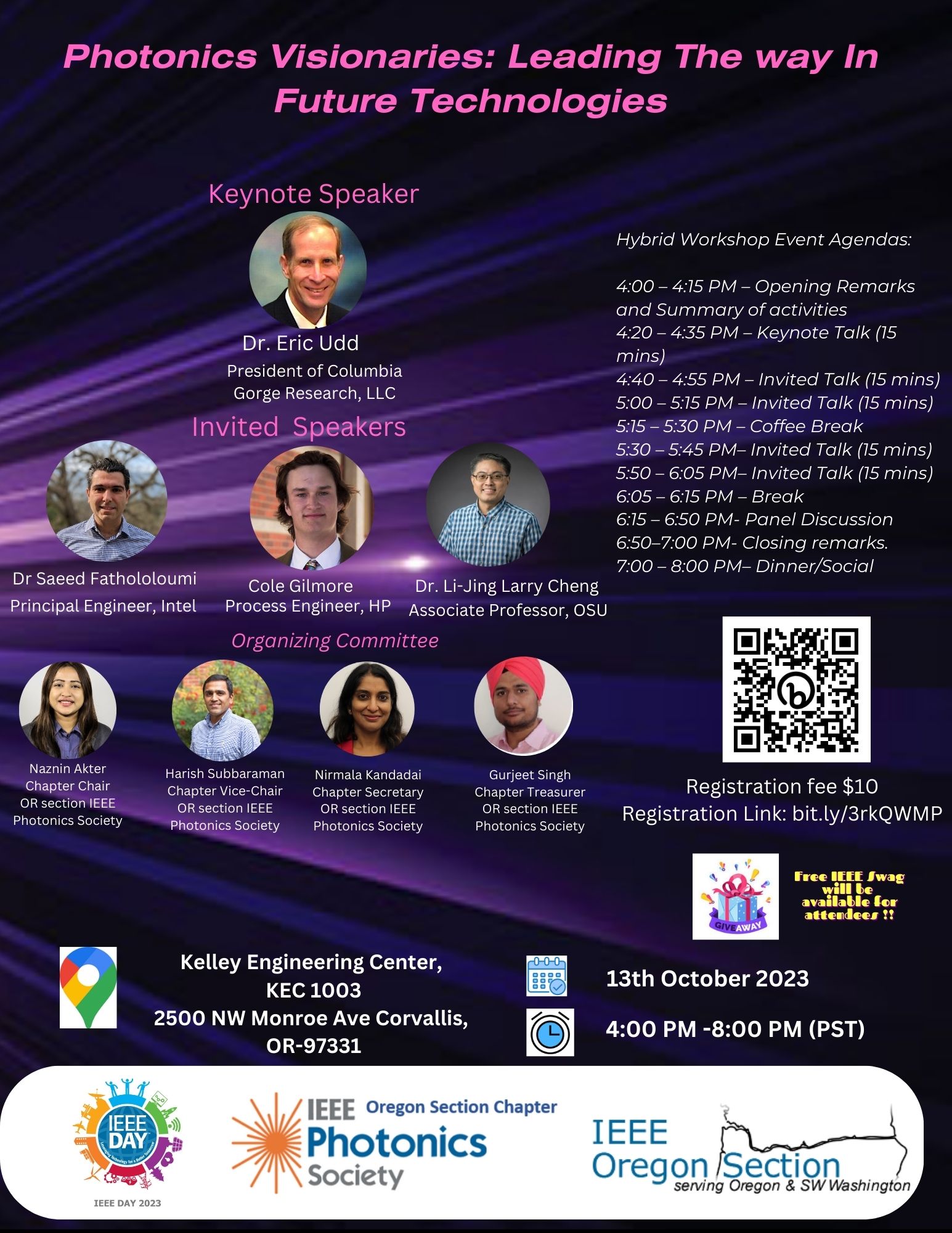
A half-day workshop is being planned by the IEEE Photonics Society Oregon Section Chapter to engage photonics academic researchers and industry professionals in the Oregon region with students. We’ll have individual talk sessions, followed by a panel discussion session and career opportunity discussions.
Date and Time
Location
Hosts
Registration
-
 Add Event to Calendar


Loading virtual attendance info...
- 2500 NW Monroe Ave
- Corvallis, Oregon
- United States 97331
- Building: Kelley Engineering Center
- Room Number: KEC 1003
- Starts 21 September 2023 08:00 AM UTC
- Ends 14 October 2023 02:00 AM UTC
- Admission fee ?
Speakers
 Dr. Eric Udd of Columbia Gorge Research, LLC
Perspectives on Past, Present and Future of Fiber Optic Sensors
Fiber optic sensors have been developed for a wide range of applications from the mid-1970s to the present. This presentation will briefly address how aerospace, defense, oil and gas, civil structure, medical and electric power markets have driven a wide range of products through synergistic relationships with the fiber optic communication and optoelectronics industries.
Biography:
Eric Udd, President of Columbia Gorge Research, LLC has been engaged full time in fiber optic sensor development since 1977. He is a McDonnell Douglas, SPIE and Optica Fellow. Mr. Udd has over 200 papers, four books and 54 issued US patents on fiber optic sensors and derivative inventions that resulted in many fielded products.
Address:United States
 Dr. Saeed Fathololoumi of Intel Corporation
Silicon Photonics: Where we are and how it can disrupt a larger market!
Silicon photonic integrated circuits are being commoditized and hence enabling many new applications, within communication, sensing and computation fields. This talk provides an overview of the state of the technology and explains why it is ready to disrupt a larger market.
Biography:
Dr Saeed Fathololoumi is currently Principal Engineer at Intel, where he is leading the Silicon Photonics Integrated Circuit development for Co-packaged optics and optical compute interconnect applications. He has more than 15 years of experience in developing technologies and qualifying them for novel optoelectronic devices and systems. He worked previously at Elenion Technologies, Mellanox, Kotura and National Research Council of Canada. He obtained his PhD in Electrical and Computer Engineering from University of Waterloo. He has more than 70 journal and conference papers with over 2600 citations, a book chapter and 26 patents.
 Cole Gilmore of HP Inc.
Applications of Lasers for Micro Mechanical Electrical Systems
HP Corvallis has innovated constantly to deliver quality consumer electronics over the years. Of the many technologies our site has to offer, one of our strengths is using lasers for product manufacturing. Examples of these processes range from plastic welding and laser marking to precision micromachining. To achieve these results, different wavelengths, powers, and pulse durations are used. In this presentation we will discuss specific laser applications HP Corvallis has developed, ranging from industry standard techniques like wafer marking and stealth dicing, to more unique processes like micromachining silicon and custom mask designs.
Biography:
Cole Gilmore is a process engineer in the fab at HP Corvallis working with high power lasers for micromachining. I earned my bachelor’s degree in physics from Oregon State in 2019, and my master’s degree in applied physics with a focus in semiconductor processing at the University of Oregon in 2020. In my free time I enjoy playing music around Corvallis!
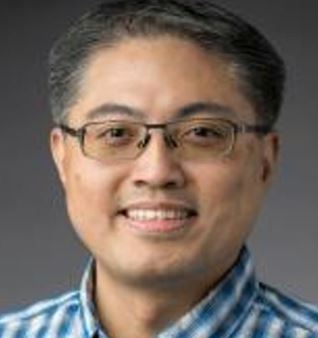 Dr. Li-Jing Larry Cheng of Oregon State University
Nanophotonics and Functional Materials: A Synergy for Enhanced Optical Biosensing
Fluorescence-based detection is a widely adopted analytical technique in biotechnology and medical diagnostics, prized for its exceptional sensitivity and reliability. Nonetheless, implementing this biosensing technique requires a specialized setup to detect weak fluorescent signals effectively. In this talk, I will discuss strategies involving photonic and nanomaterial designs to enhance fluorescence detection with a simplified workflow, making it suitable for point-of-care applications.
Biography:
Dr. Li-Jing (Larry) Cheng is an associate professor of electrical and computer engineering. His research aims to explore the unique physical and chemical properties of nanoscale materials to create devices tailored for applications in point-of-care diagnostics, wearable sensors, and optoelectronics. He received his Ph.D. degree in electrical engineering at the University of Michigan.
 Dr. Harish Subbaraman of Oregon State University
Flexible Optoelectronic Device Architectures for Tomorrow’s System Needs
As the demand for new emerging technologies and applications is increasing, the devices and architectures are constantly being upgraded or transformed. One such transformational field of study, namely flexible hybrid optoelectronics, deals with the integration of unconventional materials within flexible or rigid device architectures to provide capabilities beyond those currently available in applications ranging from communication networks; agriculture, environmental and structural monitoring; and medicine to extreme environments such as those present in space, deep-earth, and nuclear reactors. In this talk, I will highlight our work within the Advanced Manufacturing and Photonics Laboratory wherein we utilize unique materials, processing methods, and designs best suited to solve challenges for futuristic system needs.
Biography:
Dr. Harish Subbaraman received the M.S. and Ph.D. degrees in electrical engineering from The University of Texas at Austin, in 2006 and 2009, respectively. He is currently an Associate Professor in the School of Electrical Engineering and Computer Science at Oregon State University. From 2016 to 2022, he was a faculty member in the Department of Electrical and Computer Engineering at Boise State University. Prior to that, he was a senior research scientist at Omega Optics in Austin, TX, where he worked on printed and flexible photonics and electronics; and silicon and polymer based optical interconnects. Currently, he directs the Advanced Manufacturing and Photonic Laboratory (AMPL). His areas of research focus are – (1) additive manufacturing: printed electronics/optoelectronics, flexible hybrid electronics, conformal phased array antennas, materials and process development, and AI-enabled print process optimization, 2) photonics: silicon photonics, RF photonics, optical interconnects, and fiber optics. Dr. Subbaraman has 9 issued patents and has over 200 publications in refereed journals and conferences.
Agenda
-
4:00 – 4:15 PM – Opening Remarks and Summary of activities- Dr. Naznin Akter
-
4:20 – 4:35 PM – Keynote Talk (15 mins) - Eric Udd
-
4:40 – 4:55 PM – Invited Talk (15 mins) - Dr. Saeed Fathololoumi
-
5:00 – 5:15 PM – Invited Talk (15 mins) - Dr. Harish Subbaraman
-
5:15 – 5:30 PM – Coffee Break
-
5:30 – 5:45 PM– Invited Talk (15 mins) - Cole Gilmore
-
5:50 – 6:05 PM– Invited Talk (15 mins) - Dr. Li-Jing Larry Cheng
-
6:05 – 6:15 PM – Coffee Break
-
6:15 – 6:50 PM- Panel Discussion - Dr. Nirmala Kandadai
-
6:50–7:00 PM- Closing remarks - Dr. Naznin Akter
-
7:00 – 8:00 PM– Dinner/Social