

IEEE CIS Guangzhou Chapter Robotics and Intelligent Control Forum


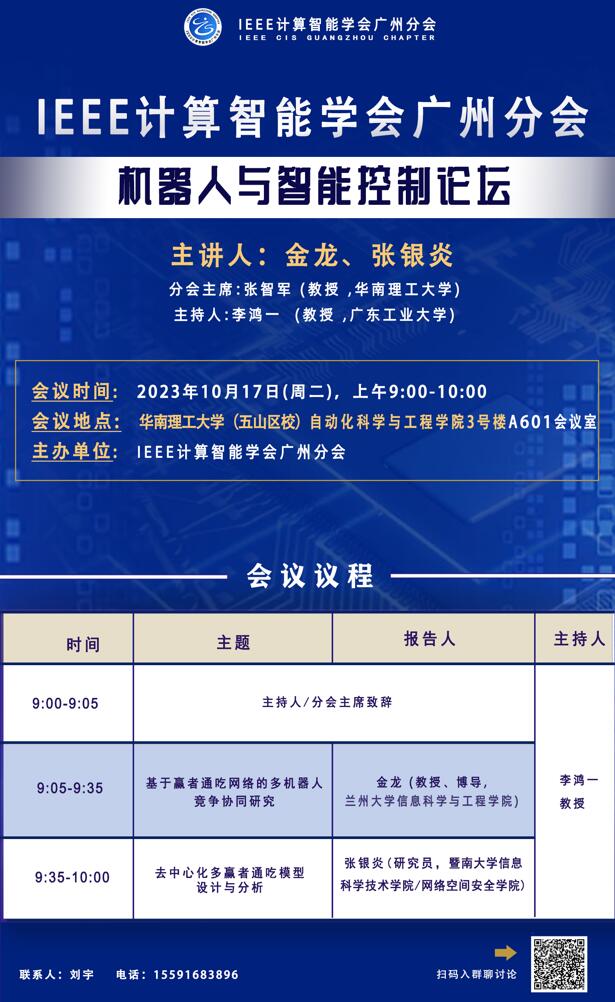
In this Forum, we invited two authorities in the field of Winner Take All (WTA) research to share their research results and experiences with us.
Date and Time
Location
Hosts
Registration
-
 Add Event to Calendar


- Room 601, Building 3, South China University of Technology, #381, Wushan RD.,
- Tianhe District, Guangzhou, Guangdong Province
- 广州, Guangdong
- China 511000
- Building: Building 3
- Room Number: 601
Speakers
Long Jin of Lanzhou University
A Study of Multi-Robot Competitive Collaboration Based on Winner-Take-All Networks
Multi-robot systems draw inspiration from behavioural mechanisms present in biological and social groups, exhibiting both synergistic and competitive states. Each state offers distinct benefits and finds use in myriad applications. A competitive phenomenon, called the winner-take-all (WTA), is typical in these systems, and helps identify superior individuals from incoming inputs, thus maximising the system's performance advantages. Furthermore, aside from its use in task allocation and collaborative behaviour, the Winner-Takes-All mechanism can also be applied in resource allocation, path planning, decision making and other fields. This technique facilitates the efficient usage of scarce resources and the rapid and precise decision making within cut-throat contexts. This presentation will provide an objective overview of the research background and current status of competitive collaboration among multiple robots.
Biography:
Jinlong obtained his Bachelor of Science and Doctor of Philosophy degrees from Sun Yat-sen University in 2011 and 2016, respectively. He served as a postdoctoral researcher in the Computing Department at the Hong Kong Polytechnic University from 2016 until 2017. He assumed the positions of professor and doctoral supervisor in the School of Information Science and Engineering at Lanzhou University in February 2017 and was named a "Cuiying Scholar" Distinguished Professor of Lanzhou University in 2020. In 2020, he was named a "Cuiying Scholar" by Lanzhou University. He has been selected multiple times as one of the Highly Cited Chinese Researchers by Elsevier. He was also awarded the Outstanding Doctoral Dissertation Award by the Chinese Society of Artificial Intelligence in 2018, the Wu Wenjun Artificial Intelligence Worried Youth Award and Gansu Provincial Science and Technology Award in 2021, and the second prize in natural science in 2022. Additionally, the student thesis under his supervision has been selected as an excellent dissertation at both the national level society and Gansu Province on five occasions. He currently holds the position of an associate editor for several SCl journals. His research interests encompass neural networks, robotics, distributed systems, and intelligent computing.
Address:Lanzhou, China
Yinyan Zhang of Jinan University
Design and Analysis of Decentralised Multi-Winner-Take-All Models
Caltech academics initially introduced the multi-winner-take-all problem at NeurlPS in 1988, which is a prominent conference on artificial intelligence. They subsequently developed the first multi-winner-take-all model based on Hopfield neural network. Multi-robot task allocation and parallel sorting are examples of practical problems that may be represented as multi-winner take-all problems. Over the last two decades, numerous scholars from circuits, neural networks, signal processing, and other disciplines have proposed centralised multi-winner take-all models suffering from poor scalability, weak robustness, and privacy leakage, among other issues. This presentation will introduce advancements in designing and analysing decentralised multi-winner take-all models.
Biography:
Yinyan Zhang holds the position of full senior researcher at the School of Information Science and Technology/School of Cyberspace Security, Jinan University. He earned his PhD from the Hong Kong Polytechnic University in 2019. His research interests centre around multi-intelligent body system control and security, along with dynamic neural networks. He leads the sub-projects of the Key R&D Programme of the Ministry of Science and Technology, the youth project of the Natural Science Foundation of China, and the surface project of the Guangdong Provincial Foundation. He has authored several first papers in IEEE TAC, Automatica, IEEE TNNLS and other journals. Currently, he is a board member for editorial duties for IEEE Transactions on Industrial Electronics, Neural ProcessingLetters, and other journals.
Address:Guangzhou, China