

Regular meeting of microwave technology enthusiasts


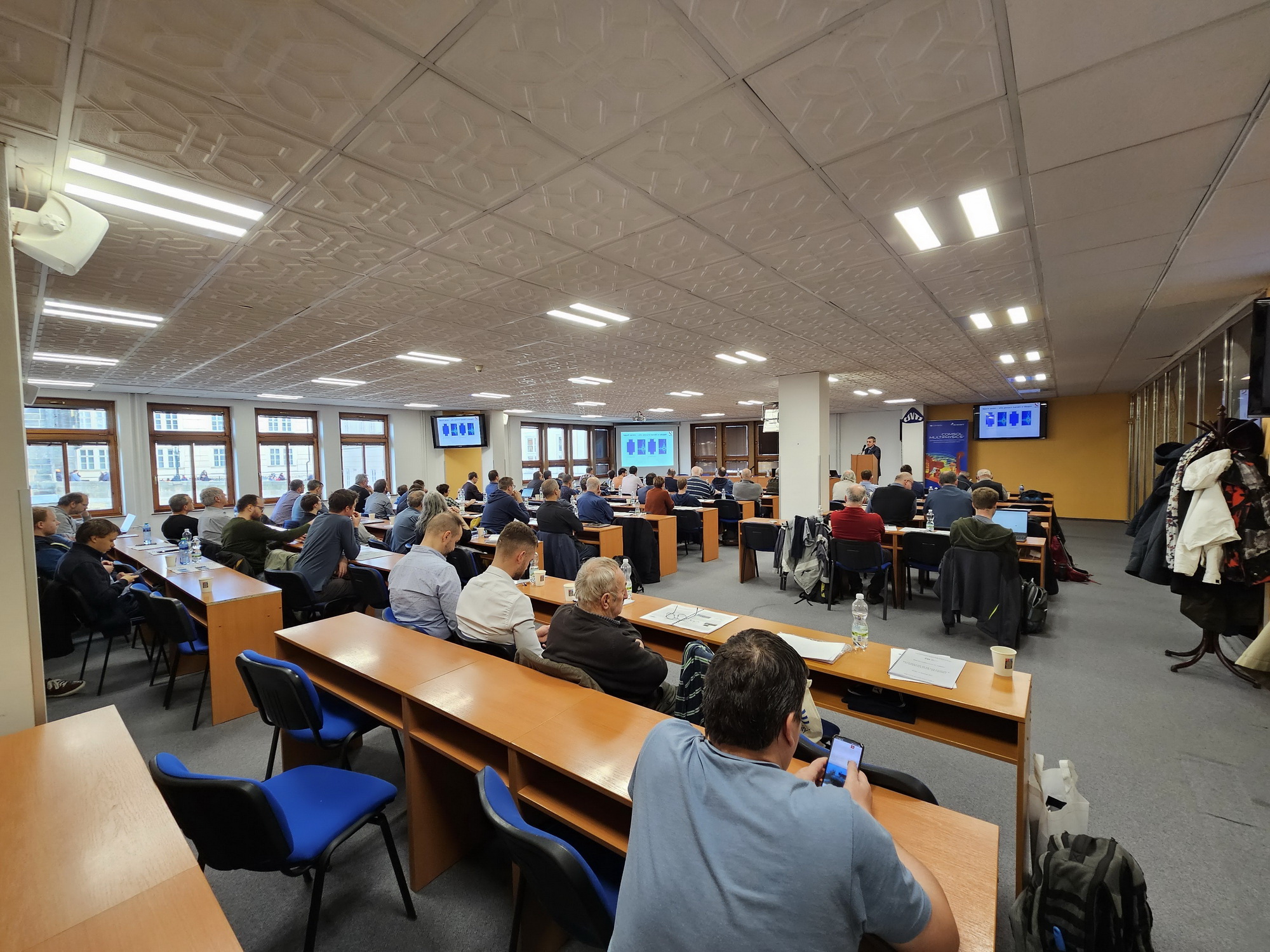
57th seminar for microwave technology enthusiasts.
Take advantage of this exceptional opportunity to meet with colleagues working in the field, establish, renew, or deepen personal or professional contacts. We look forward to meeting you and cordially invite you to the seminar with an accompanying exhibition of products from companies operating in the field of high-frequency and microwave technology.
Date and Time
Location
Hosts
Registration
-
 Add Event to Calendar


- Novotného lávka 1
- Prague, Czech Republic
- Czech Republic
Agenda
The introductory lecture presents the development of 3D radar with electronically steerable antenna arrays. The presentation does not limit itself to microwave design aspects but aims to illustrate the development of the entire life cycle context (Systems Engineering), the top-down design approach, and the need to consider aspects from various engineering disciplines, such as the integration of microwave design with digital signal processing (digital beamformer).
Reconfigurable antennas find applications in surveillance systems for target detection, protection of specific areas, communication for automatic participant detection, and optimization of individual connections. Attention is given to antennas whose radiation pattern maxima direction is electronically controlled by changing the DC voltage that controls the varactor capacitances. Another way to control the direction of radiation pattern maxima is to change the amplitudes of the power signals applied to individual ports.
The software COMSOL Multiphysics is traditionally based on the finite element method (FEM). To cover a wide range of simulations, it uses other numerical methods and can combine them in so-called hybrid models. This modeling approach is key to capturing complex electromagnetic behavior and interactions with different materials and structures. The software can also include other physical phenomena in a single simulation, such as heat transfer, fluid flow, or structural deformations. The interconnection of different physical domains and a comprehensive analysis of their interactions bring new perspectives and enable more accurate simulations in a real environment. The microwave heating and the influence of structural deformations on system functionality are discussed in detail.
Air traffic control relies mainly on secondary radars and multilateration when detecting aircraft operating at frequencies of 1030 and 1090 MHz. These sensors query aircraft, or more generally, entities equipped with transponders, and wait for responses to their queries. In case of a high volume of queries, the transponder may become overloaded and stop responding altogether. In such cases, targets can only be detected by primary radar, but its use is decreasing in civilian air traffic control. The presentation will describe frequency users and the current state of frequency congestion. Furthermore, it will present the consequences of transponder overloads and recent specific events in interrogations.
Estimating the number of people in a room using Wi-Fi leverages communication between mobile devices and infrastructure in the form of Wi-Fi packet probing requests. Data is captured using sniffers based on ESP32 microcontroller boards and then processed using the Python language. This allows for estimating the total number of people (or mobile devices) in a building.
Electroforming is a classic additive manufacturing technology for creating copper microwave waveguides, waveguide transitions, filters, or antennas. It still plays a significant role in the production of precision microwave components. A completely new approach offers the combination of 3D printing of polymers or ceramics and electrochemical plating in the form of thin (in the order of 0.01 mm) or thick (in the order of 0.1 mm) copper or nickel layers.
The introductory lecture for the discussion evening deals with the course of the first Czech attempt at a solo circumnavigation of the world without stopping and assistance in 2011/2012, associated with breaking the then-world record on a self-built 8.5-meter sailboat named Singa. Attention will be given to the boat's equipment with electronics for ensuring the safety of the voyage within the international maritime distress and safety GMDSS, navigation, vessel control, and for securing essential life needs. The communication equipment for radio voice and data communication via satellite systems Inmarsat will be presented in more detail.