

Towards Fast, Scalable and Generalized Network Performance Estimation


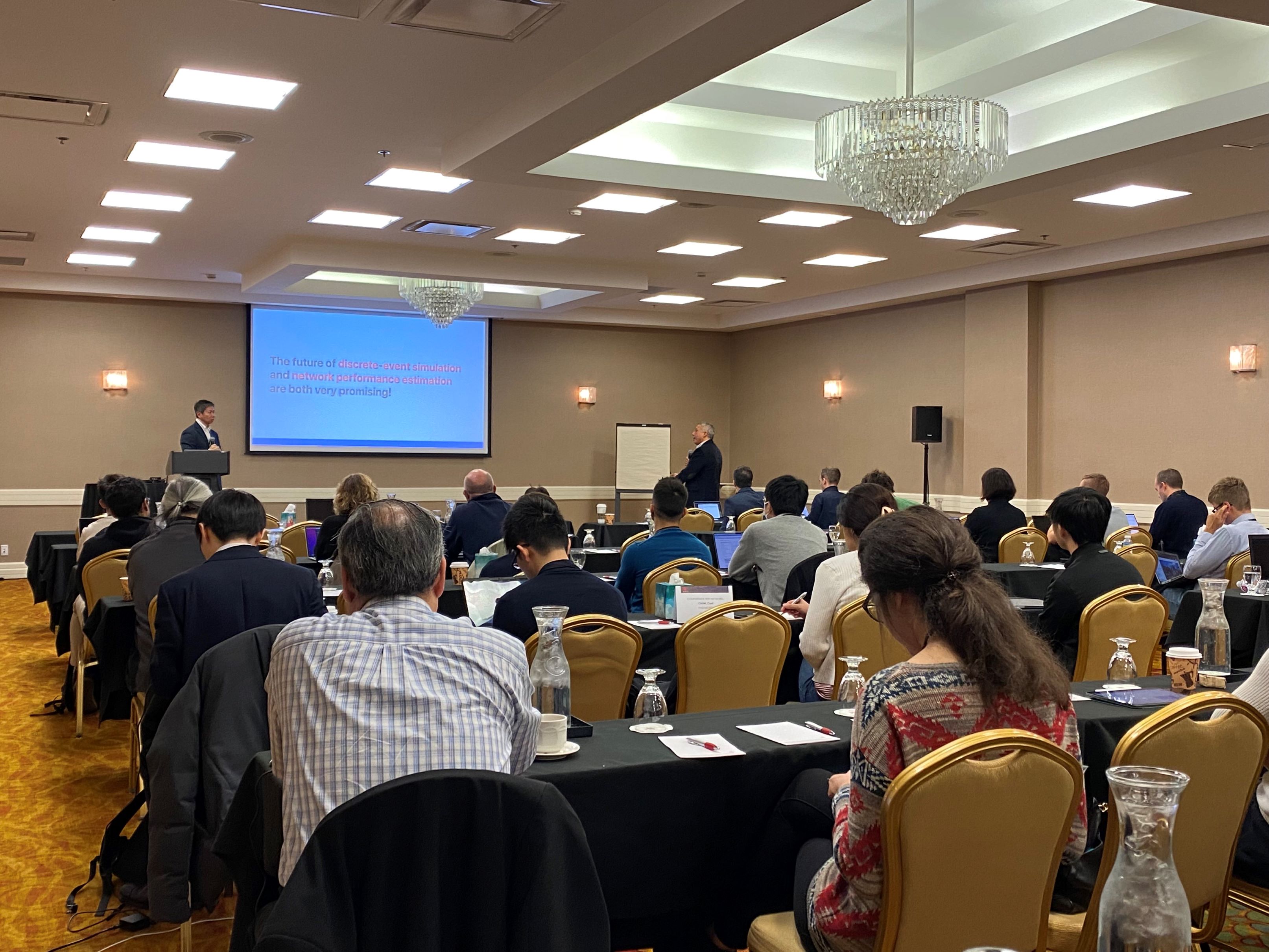
The unprecedented surge in the scale of network topologies and traffic has fueled a pressing demand for rapid simulation of new network designs, prior to both emulation and real-world deployment. However, conventional network simulation techniques do not scale well, due to their high computational costs and low degrees of parallelism. In response, network performance estimators have emerged as a promising alternative, leveraging parallel inference of deep neural networks for acceleration. However, these estimators still face challenges in achieving satisfactory scalability and generality.
In this talk, we introduce some of our recent work on improving the performance, scalability and generality of network performance estimation. I will first introduce DeepQueueNet, our work on using deep neural network models to emulate the behaviour of network devices, supporting arbitrary network topologies and device traffic management mechanisms. For generating training data samples, the design and implementation of DeepQueueNet depended upon our recent work on a new Python-based discrete event simulator, which I developed from scratch. Our extensive experiments showed that DeepQueueNet achieved near-linear speedup in the number of GPUs, and its estimation accuracy for average and 99th percentile round-trip time outperforms existing end-to-end DNN-based performance estimators. I will conclude the talk with key insights in our ongoing work to improve DeepQueueNet.
Date and Time
Location
Hosts
Registration
-
 Add Event to Calendar


Speakers
 Baochun Li of University of Toronto, Canada
Towards Fast, Scalable and Generalized Network Performance Estimation
The unprecedented surge in the scale of network topologies and traffic has fueled a pressing demand for rapid simulation of new network designs, prior to both emulation and real-world deployment. However, conventional network simulation techniques do not scale well, due to their high computational costs and low degrees of parallelism. In response, network performance estimators have emerged as a promising alternative, leveraging parallel inference of deep neural networks for acceleration. However, these estimators still face challenges in achieving satisfactory scalability and generality.
In this talk, we introduce some of our recent work on improving the performance, scalability and generality of network performance estimation. I will first introduce DeepQueueNet, our work on using deep neural network models to emulate the behaviour of network devices, supporting arbitrary network topologies and device traffic management mechanisms. For generating training data samples, the design and implementation of DeepQueueNet depended upon our recent work on a new Python-based discrete event simulator, which I developed from scratch. Our extensive experiments showed that DeepQueueNet achieved near-linear speedup in the number of GPUs, and its estimation accuracy for average and 99th percentile round-trip time outperforms existing end-to-end DNN-based performance estimators. I will conclude the talk with key insights in our ongoing work to improve DeepQueueNet.
Biography:
Baochun Li received his B.Engr. degree from the Department of Computer Science and Technology, Tsinghua University, China, in 1995 and his M.S. and Ph.D. degrees from the Department of Computer Science, University of Illinois at Urbana-Champaign, Urbana, in 1997 and 2000. Since 2000, he has been with the Department of Electrical and Computer Engineering at the University of Toronto, where he is currently a Professor. He holds the Bell Canada Endowed Chair in Computer Engineering since August 2005. His current research interests include cloud computing, security and privacy, distributed machine learning, federated learning, and networking.
Dr. Li has co-authored more than 450 research papers, with a total of over 24000 citations, an H-index of 87 and an i10-index of 323, according to Google Scholar Citations. He was the recipient of the IEEE Communications Society Leonard G. Abraham Award in the Field of Communications Systems in 2000, the Multimedia Communications Best Paper Award from the IEEE Communications Society in 2009, the University of Toronto McLean Award in 2009, and the Best Paper Award from IEEE INFOCOM in 2023. He is a Fellow of the Canadian Academy of Engineering and a Fellow of IEEE.