

AI4Meta: Inverse Design of Microwave Metasurfaces Driven by Knowledge/Experience or Statistics?


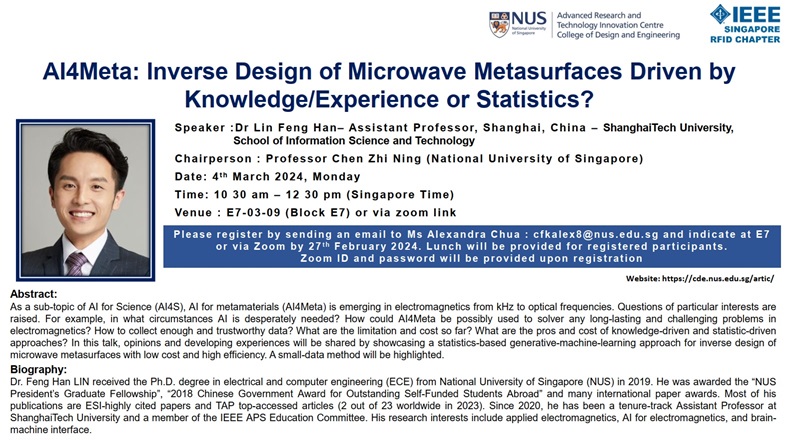
As a sub-topic of AI for Science (AI4S), AI for metamaterials (AI4Meta) is emerging in electromagnetics from kHz to optical frequencies. Questions of particular interests are raised. For example, in what circumstances AI is desperately needed? How could AI4Meta be possibly used to solve any long-lasting and challenging problems in electromagnetics? How to collect enough and trustworthy data? What are the limitation and cost so far? What are the pros and cost of knowledge-driven and statistic-driven approaches? In this talk, opinions and developing experiences will be shared by showcasing a statistics-based generative-machine-learning approach for inverse design of microwave metasurfaces with low cost and high efficiency. A small-data method will be highlighted.
Date and Time
Location
Hosts
Registration
-
 Add Event to Calendar


- Engineering Block E7
- Singapore, Singapore
- Singapore 117583
- Building: Block E7
- Room Number: E7-03-09
- Starts 26 February 2024 10:00 AM UTC
- Ends 04 March 2024 05:00 AM UTC
- No Admission Charge
Speakers
ShanghaiTech University
AI4Meta: Inverse Design of Microwave Metasurfaces Driven by Knowledge/Experience or Statistics?
As a sub-topic of AI for Science (AI4S), AI for metamaterials (AI4Meta) is emerging in electromagnetics from kHz to optical frequencies. Questions of particular interests are raised. For example, in what circumstances AI is desperately needed? How could AI4Meta be possibly used to solve any long-lasting and challenging problems in electromagnetics? How to collect enough and trustworthy data? What are the limitation and cost so far? What are the pros and cost of knowledge-driven and statistic-driven approaches? In this talk, opinions and developing experiences will be shared by showcasing a statistics-based generative-machine-learning approach for inverse design of microwave metasurfaces with low cost and high efficiency. A small-data method will be highlighted.
Dr. Feng Han LIN received the Ph.D. degree in electrical and computer engineering (ECE) from National University of Singapore (NUS) in 2019. He was awarded the “NUS President’s Graduate Fellowship”, “2018 Chinese Government Award for Outstanding Self-Funded Students Abroad” and many international paper awards. Most of his publications are ESI-highly cited papers and TAP top-accessed articles (2 out of 23 worldwide in 2023). Since 2020, he has been a tenure-track Assistant Professor at ShanghaiTech University and a member of the IEEE APS Education Committee. His research interests include applied electromagnetics, AI for electromagnetics, and brain-machine interface.
Biography:
Dr. Feng Han LIN received the Ph.D. degree in electrical and computer engineering (ECE) from National University of Singapore (NUS) in 2019. He was awarded the “NUS President’s Graduate Fellowship”, “2018 Chinese Government Award for Outstanding Self-Funded Students Abroad” and many international paper awards. Most of his publications are ESI-highly cited papers and TAP top-accessed articles (2 out of 23 worldwide in 2023). Since 2020, he has been a tenure-track Assistant Professor at ShanghaiTech University and a member of the IEEE APS Education Committee. His research interests include applied electromagnetics, AI for electromagnetics, and brain-machine interface.
Email:
Address:Singapore