

IEEE CSS Control Science Frontier Academic Salon--Reliably Learn to Trim Multiparametric Quadratic Programming


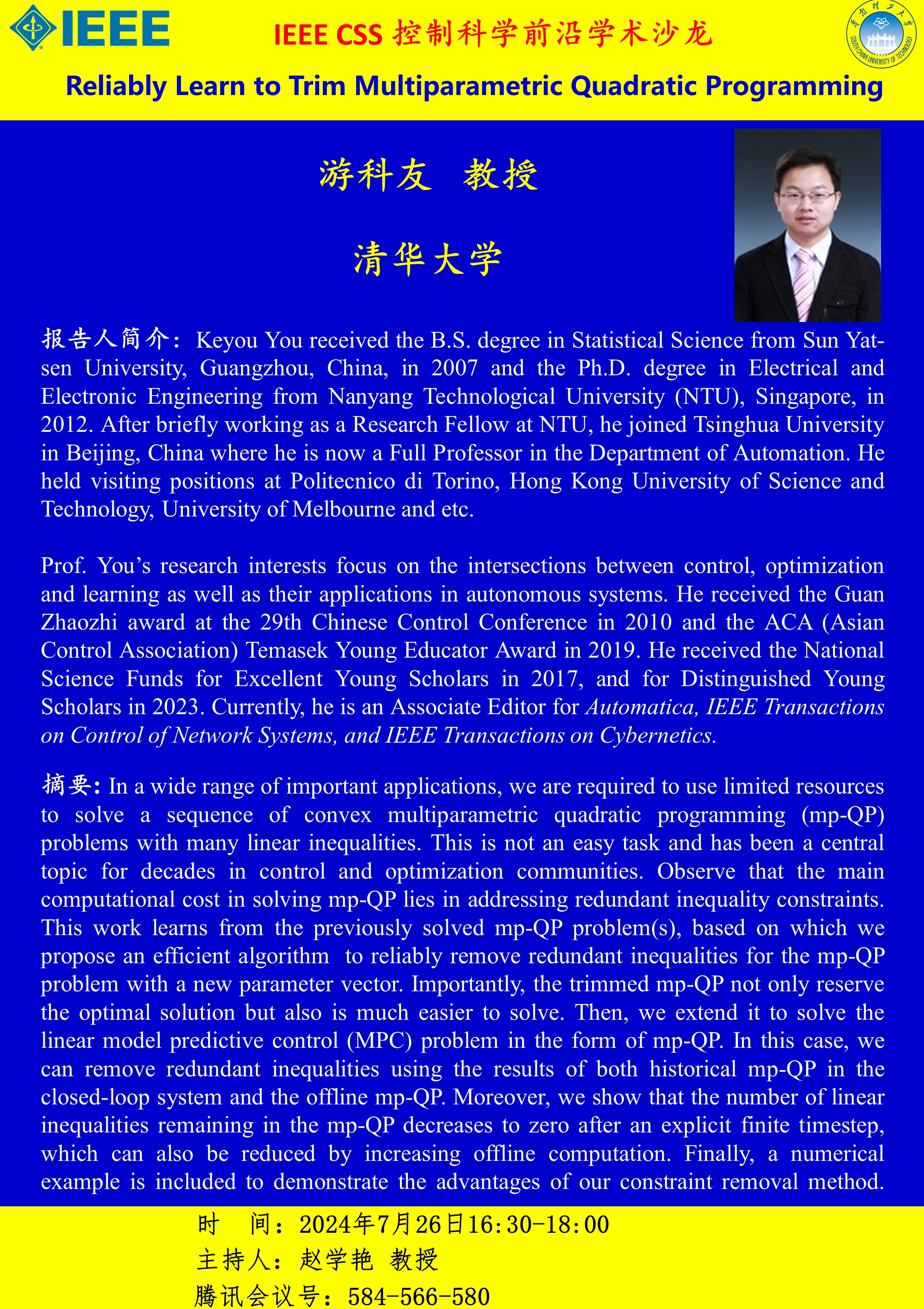
In a wide range of important applications, we are required to use limited resources to solve a sequence of convex multiparametric quadratic programming (mp-QP problems with many linear inequalities. This is not an easy task and has been a central topic for decades in control and optimization communities. Observe that the main computational cost in solving mp-QP lies in addressing redundant inequality constraints. This work learns from the previously solved mp-QP problem(s), based on which we propose an efficient algorithm to reliably remove redundant inequalities for the mp-QP problem with a new parameter vector. Importantly, the trimmed mp-QP is not only the optimal solution but also is much easier to solve. Then, we extend it to solve the linear model predictive control (MPC) problem in the form of mp-QP. In this case, we can remove redundant inequalities using the results of both historical mp-QP in the closed-loop system and the offline mp-QP. Moreover, we show that the number of linear inequalities remaining in the mp-QP decreases to zero after an explicit finite timestep. which can also be reduced by increasing offline computation. Finally, a numerical example is included to demonstrate the advantages of our constraint removal method.
Date and Time
Location
Hosts
Registration
-
 Add Event to Calendar


- Guangzhou, Guangdong
- China
- Contact Event Host
- Co-sponsored by Feiqi Deng, Xueyan Zhao
- Starts 20 June 2024 03:58 PM UTC
- Ends 24 July 2024 04:02 PM UTC
- No Admission Charge
Speakers
Keyou You
In a wide range of important applications, we are required to use limited resources to solve a sequence of convex multiparametric quadratic programming (mp-QP problems with many linear inequalities. This is not an easy task and has been a central topic for decades in control and optimization communities. Observe that the main computational cost in solving mp-QP lies in addressing redundant inequality constraints. This work learns from the previously solved mp-QP problem(s), based on which we propose an efficient algorithm to reliably remove redundant inequalities for the mp-QP problem with a new parameter vector. Importantly, the trimmed mp-QP is not only the optimal solution but also is much easier to solve. Then, we extend it to solve the linear model predictive control (MPC) problem in the form of mp-QP. In this case, we can remove redundant inequalities using the results of both historical mp-QP in the closed-loop system and the offline mp-QP. Moreover, we show that the number of linear inequalities remaining in the mp-QP decreases to zero after an explicit finite timestep. which can also be reduced by increasing offline computation. Finally, a numerical example is included to demonstrate the advantages of our constraint removal method.
Biography:
Keyou You received the B.S. degree in Statistical Science from Sun Yat. sen University, Guangzhou, China, in 2007 and the Ph.D. degree in Electrical and Electronic Engineering from Nanyang Technological University (NTU), Singapore, in 2012. After briefly working as a Research Fellow at NTU, he joined Tsinghua University in Beijing, China where he is now a Full Professor in the Department of Automation. He held visiting positions at Politecnico di Torino, Hong Kong University of Science and Technology, University of Melbourne, etc.
Prof, You's research interests focus on the intersections between control, optimization, and learning as well as their applications in autonomous systems. He received the Guan Zhaozhi Award at the 29th Chinese Control Conference in 2010 and the ACA (Asian Control Association) Temasek Young Educator Award in 2019. He received the NationalScience Funds for Excellent Young Scholars in 2017, and for Distinguished Young Scholars in 2023. Currently, he is an Associate Editor for Automatica, IEEE Transactions on Control of Network Systems, and IEEE Transactions on Cybernetics.
Email:
Address:China