

2026 IEEE Rochester NY JOINT CHAPTERS MEETING


Join the Rochester Section at one of our outstanding annual events.
The IEEE Rochester NY Section Joint Chapter Meeting is
March 26th, 2026
Don’t miss this excellent opportunity to meet and network with people from all engineering disciplines and learn more about the activities of the different IEEE Society Chapters in the Rochester area.
The IEEE Rochester Joint Chapters Meeting (JCM) features:
- 6 technical presentations from IEEE Society Chapters (in 3 parallel tracks),
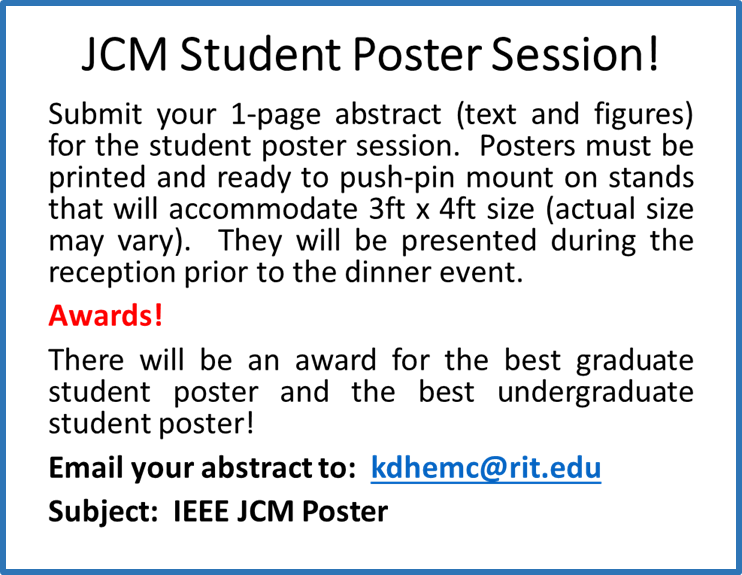
- Student poster session with Best Grad and Best Undergrad poster prizes!!! 1st=$200, 2nd=$100.
- Professional networking with crudités and a cash bar,
- An "ALL-AMERICAN BUFFET" dinner featuring Roasted Salmon, Chicken French, Grilled Vegetable Napoleon (vegan), and more.
- Keynote presentation by Dr. Kyle J. Myers
Fellow, Hagler Institute of Advanced Studies, Biomedical Engineering
Registration is required.

Registration Pricing: BEFORE Monday, March 16, 11:59 PM
- $30 IEEE Member or IEEE Member's significant other
- $40 Non-member
- $10 IEEE Student Member
- $20 Non-IEEE Student Member
- $20 IEEE Life Member or IEEE Fellow
Registration Pricing AFTER Monday, March 16, 11:59 PM, add $5.
Please come back to this site for updates on the JCM presentations.
Date and Time
Location
Hosts
Registration
-
 Add Event to Calendar


- RIT Inn & Conference Center
- 5257 W Henrietta Rd, Henrietta, NY 14467
- Henrietta, New York
- United States 14467
- Click here for Map
- Starts 12 October 2025 04:00 AM UTC
- Ends 26 March 2026 04:00 AM UTC
- Admission fee ?
Speakers
GRSS Speaker: Dr. Grover Swartzlander of RIT
Earth Cup - A Stepping Stone Toward Earth Shading
Runaway global warming is projected to accelerate desertification and loss of habitat in the coming decades. Few options are available to reverse the natural release of stored greenhouse gases (e.g., from wildfires and tundra thawing) that were initially triggered by human causes. What is more, few geoengineering approaches provide sustainable worldwide cooling. Sunshades placed at the Earth-Sun Lagrange point (L1) provide a controlled method to cool the planet by directing heat-generating sunlight away from the Earth. The Earth Cup initiative seeks to build the technical readiness of sunshades via a series of worldwide challenges, first involving student-led teams that will participate in solar sailing races to low Earth orbit, followed by cis-lunar orbits and beyond. The eventual placement of a large constellation of solar sails in halo orbits about the L1 point requires planning and action now, e.g., the building of enthusiasm, infrastructure, and a workforce. The Earth Cup race to LEO is the first step of that multi-decadal process.
Earth Cup is led by concerned individuals having combined experience with large-scale social projects, diplomacy, education, space systems, digital twinning, and global warming modeling. Dr. Grover Swartzlander leads the Education Committee and serves on the Technical Committee.
Biography:

Dr. Grover Swartzlander
Professor, Chester F. Carlson Center for Imaging Science
Dr. Grover Swartzlander received a PhD from the Johns Hopkins University in 1990, an MSEE from Purdue University in 1985, and a BS in Physics from Drexel University in 1982. Between 1990 and 1993 he was a postdoctoral fellow at the US Naval Research Laboratory. Before joining the Center for Imaging Science at the Rochester Institute of Technology, he held academic appointments at the Worcester Institute of Technology and the University of Arizona. He is a Fellow of the Optical Society of America (now Optica), a NASA Innovative Advanced Concepts Fellow, a Cottrell Scholar, and Wakonse Fellow. He served as Editor-in-Chief of the Journal of the Optical Society of America, B from 2013-2018. His research interests have spanned a range of topics in optics including radiation pressure, advanced imaging concepts for terrestrial and space application, optical vortices, nonlinear optics, coherence, geometric phase, and metamaterials. His research has been cited more than 9,000 times and carries an h-index of 43.
Email:
Address:Rochester, New York, United States, 14623
Signal Processing Speaker: Flip Phillips of RIT
The State of AI in Filmmaking, 2026
Drawing and, subsequently, painting gave us the attempted imitation of the visual world. Photography promised its capture. Computer graphics exposed this promise as an illusion. And now AI completes the circle, revealing that every image, still or moving, has always been a fabrication, just made with different instruments. From the caves of Lascaux, images have been about the human desire to communicate, to tell stories, to share visions of reality or, more importantly, _possible ones_. The tools have changed, but the impulse remains the same. Hand in hand, the tools have changed us as well. What is there to believe about depictions -- Seeing is no longer believing.
Currently, there is a widespread anxiety both about the authenticity of images and about the potential for AI to replace or destroy the artist and the creative process entirely. Throughout the history of art, new technologies have been met with similar fears. Photography was once thought to be a threat to painting, yet it ultimately expanded the possibilities of visual expression. As a nominal pioneer in computer graphics, I have witnessed firsthand how its technology was, at first, perceived as an existential threat to traditional art forms, only to become a new tool _and_ medium for creativity and innovation.
Like computer graphics, generative AI is a force that will ultimately be integrated into the process of visual creation. Furthermore, it is silly to assume that AI has not already been used in the creation of images, static and moving, for decades. The ongoing challenge is to understand and harness the evolving power of these tools to _collaborate_ with human creativity rather than to _compete_ with it.
This talk will examine current uses of technology that are in the spirit of collaboration rather than competition, especially with respect to motion pictures and their production.
Biography:
Dr. Flip Phillips
Professor, School of Film and Animation, RIT

Dr. Flip Phillips is a Professor of Motion Picture Science in the School of Film and Animation at the Rochester Institute of Technology (RIT), where he joined the faculty in 2020. He established the university’s virtual production curriculum, blending filmmaking with real-time rendering and computational photography.
Earlier in his career, he worked as an Animation Scientist at Pixar from 1987 to 1992. There, he contributed to the development of RenderMan — the groundbreaking 3D rendering software behind films such as Toy Story, Finding Nemo, and Ratatouille. He was part of the original team that created RenderMan’s shading language and worked on the Academy Award-winning short film Tin Toy.
Dr. Phillips’ research focuses on human perception of materials, 3D shape, and motion. In 2024, he and his former Pixar colleagues received the IEEE Milestone Award for their work on RenderMan.
Email:
Address:Rochester, New York, United States, 14623
Nick Donofrio
Navigating OSHA Compliance a practical roadmap
This presentation provides local businesses with a practical roadmap for understanding OSHA. Workplace safety is a critical business advantage rather than a group of regulations. The session covers OSHA basics, details the Top 5 OSHA Violations (like Fall Protection and Lockout/Tagout), and emphasizes moving to a proactive safety culture through regular inspections and comprehensive training. Ultimately, the guide helps businesses build essential written safety plans and avoid costly citations.
Biography:

Mr. Nick Donofrio
Safety Consultant, NYS DOL Certified Safety Consultant. PinPoint Safety Consulting
Mr. Donofrio began his safety career in the private sector working more than two decades in the chemical industry where he was responsible for overseeing hazard identification, safety & health management and process safety activities at multiple Fortune 500 chemical manufacturing facilities. He joined the Occupational Safety and Health Administration (OSHA) in 2005 as a Safety and Health Compliance Officer in the Buffalo area office. During his tenure as a compliance officer, he conducted more than 800 safety and health inspections. He was a four-time recipient of the Secretary of Labor’s Exceptional Achievement Award and the Secretary’s Honor Award for Worker Protection and was presented the Regional Administrator’s Strong Enforcement award three times. Selected to fill the positon of Compliance Assistance Specialist for OSHA’s New York City Region in 2019, he conducted outreach, education, training, and relationship building to business groups, associations, unions, and community groups to assist OSHA fulfilling one of its primary missions: compliance assistance. Accepting OSHA’s offered of deferred resignation, he left his full-time position in April of 2025 and immediately began working on launching his safety consulting business. His goal, share more than 40 years of unique and wide-ranging safety experience assisting employers protect their greatest asset, their employees
Email:
Address:New York, United States
Zhongwang Dou of Rochester Institute of Technology
Engineering in Medicine and Biology Society Presentation."
Cardiovascular disease (CVD) is the leading cause of death and a major contributor to healthcare costs in the United States and worldwide. In-vitro methods provide unique advantages for exploring fundamental questions and advancing the development of biomedical devices for CVD. In this talk, I will present efforts by my research group to address key challenges in understanding and treating stroke diseases through in-vitro experimental approaches.
Biography:

Dr. Zhongwang Dou
Assistant Professor, Biomedical Engineering, Dept. of Biomedical Eng., College of Engineering, RIT
Dr. Dou obtained his PhD degree in Mechanical Engineering from the University at Buffalo in 2017. He completed his postdoctoral training at Johns Hopkins University and Purdue University. Dr. Dou's research group studies fundamental questions related to cardiovascular diseases through a fluid mechanics point of view, such as stroke and hemodynamics. The group also investigates novel medical devices for treating such diseases and identifies potential improvements needed for these devices.
Email:
Address:Rocheser, New York, United States
Dan Neuman
The Rochester Intelligent Imaging Initiative (RI3)
The Rochester Intelligent Imaging Initiative is a new UR & RIT endeavor to promote technology growth in Western NY for innovative, smart imaging systems and to advance national awareness of our regional expertise & capabilities in both AI and Imaging.
Intelligent imaging represents the convergence of optics, sensors, computing, and AI. Together, these technologies are redefining how visual information is captured, analyzed, and used to guide decisions. In a world increasingly defined by visual data, intelligent imaging is becoming one of the most powerful tools we have for understanding - and shaping - the world around us.
This talk describes the background, motivation and current efforts underway at the UofR, RIT and regional imaging technology & manufacturing companies to establish the Rochester Intelligent Imaging Initiative (RI3). Rochester has long been known and heralded as “the Imaging Capital of the World”. We describe our efforts over the past 18+ months to harness Rochester’s foundational heritage in imaging, together with our significant regional capabilities in AI & data sciences to become the future “Intelligent Imaging” Capital of the World.
The Rochester Intelligent Imaging Initiative is a direct out-growth of two NY state funded technology development centers based at the University of Rochester:
- The Center for Emerging and Innovative Science (CEIS)
- The Center of Excellence in Data Science and AI (COE)
The first part of the talk provides a brief overview of both CEIS and the COE, and how, together with the RIT Center for Imaging Sciences (CIS), this inspired a new joint effort to launch the RI3. The second part of the talk provides details of our current efforts and near-term plans for the RI3.
Biography:

J. Daniel Newman, Ph.D
Center for Emerging and Innovative Sciences
University of Rochester
J. Daniel (Dan) Newman is the Principal Technology & Strategy consultant for CEIS at the University of Rochester. He is currently co-leading the Rochester Intelligent Imaging Initiative along with Dr. Paul Ballentine, who is the Deputy Director of CEIS.
Dan recently retired from L3Harris Space and Airborne Systems in Rochester after 35-year career as a Sr. Scientist and Program Manager. His areas of specialization at L3Harris include leadership roles in space imaging payload platform development, R&D for visible and IR sensors & systems technology, optical communications systems for terrestrial and space applications and medical imaging product development for filmless Xray systems . He began his career at Eastman Kodak Government Systems Division in Rochester, which was subsequently acquired by ITT and L3Harris.
Dan received a PhD in physics from the University of Rochester and a BS in physics from the University of Chicago. He has authored over 40 papers and conference proceedings and has 9 issued patents based on his research.
Email:
Address:New York, United States
James Herrmann
Power Integrity - Key Principles and Practices as Applied in Modern Circuit Board Design
This presentation provides an introduction to modern power integrity (PI) engineering for board-level electronics design. As integrated circuits continue to evolve, with lower core DC voltages supporting higher transient current demands, the margin for noise within a circuit board’s power distribution networks (PDNs) is exponentially shrinking, requiring increasingly sophisticated design approaches.
Using a real-world quad-DSP board as a case study this session covers fundamental PI concepts including the key attributes of defining the requisite target impedance and achieving a flat impedance profile. We will overview a modern PDN design process including the gathering of specifications and allocating noise budgets, managing the DC voltage drops within the PCB interconnects, and designing for worst case load-step current transients through proper decoupling capacitor selection, placement, and circuit board construction.
PCB layout best practices for minimizing inductance—the primary enemy in power distribution—are also covered, including optimal via fanout strategies, capacitor mounting techniques, and power/ground plane pair configurations.
This overview session is designed for board-level electronics design engineers, PCB layout designers, EMC engineers, and anyone seeking to better understand the key elements of modern power integrity engineering.
Biography:

Mr. James Herrmann
General manager at Re:Build AppliedLogix LLC
Mr. James Herrmann is the General Manager and Principal Engineer at Re:Build AppliedLogix, a Rochester-based custom embedded systems design firm. He leads a team of 85 Senior Electrical, Software, Mechanical, and PCBA Layout Engineers.
Mr. Herrmann has 35+ years of experience designing and commercializing high-performance electronic subsystems for a broad spectrum of OEM customers with diverse product applications. His career spans major corporations including Kodak and Xerox, as well as multiple high-tech firms he founded, including InSciTek Microsystems / Allworx and AppliedLogix. He has designed and delivered leading-edge electronics products that have earned industry awards and marketplace success. Throughout his career, he has developed and refined a comprehensive circuit board design methodology that consistently delivers first-pass success with robust operation and superior EMC characteristics.
Mr. Herrmann holds a BSEE from the State University of New York at Buffalo and an MSEE from the University of Rochester. He is a named inventor on four U.S. patents and has been a long-standing member of the Rochester NY Section of the IEEE.
Kyle J. Myers
Keynote: A Metaverse of ‘Medical Technology and AI’ (MeTAI): Building Blocks and Use Cases in Medical Imaging
Medical imaging offers a dazzling array of approaches for acquiring information that supports disease detection, staging, treatment selection, and follow up. Recent advances in computing power and the widespread availability of artificial intelligence (AI) algorithms have enabled rapid acquisition and processing of vast amounts of data and the very real potential for development of a metaverse for intelligent healthcare. A metaverse of ‘Medical Technology and AI’ (MeTAI) can facilitate the development, prototyping, evaluation, regulation, translation and refinement of AI-based medical practice. How then to determine when such nascent tools are ready for prime time? Image Science provides a framework for the objective, or task-based, assessment of medical imaging systems and the quality of the data they produce. This framework has been used to support the evaluation of medical imaging system hardware, image reconstruction and other image processing methods (including artificial intelligence and machine learning), and display devices by academia, industry, and FDA. This talk will trace the historical arc of progress as medical imaging systems have become more complex while the state-of-the-science for image quality assessment has similarly
advanced to meet current challenges in the design, regulatory approval and clinical evaluation of such systems.
Biography:

Dr. Kyle J. Myers
Fellow, Hagler Institute of Advanced Studies, Biomedical Engineering
Dr Kyle J. Myers earned a doctorate in Optical Sciences from the University of Arizona. For over 30 years she worked for the US FDA’s Center for Devices and Radiological Health, where she served as the Director of the Division of Imaging, Diagnostics and Software Reliability. She is best known for the development of analytical and regulatory science methods for assessing the safety and effectiveness of medical imaging devices. Her work established next-generation study designs and evaluation methods for novel medical imaging and diagnostics products including digital mammography, 3D breast imaging, low-dose CT for lung cancer screening, and whole-slide digital pathology.
Myers belongs to the National Academy of Engineering. In addition to being a Fellow of the Hagler Institute for Advanced Study at Texas A&M University, she is a fellow of the American Association of Physicists in Medicine (AAPM), the American Institute for Medical and Biological Engineering (AIMBE), the International Society for Optics and Photonics (SPIE), and Optica. She served on SPIE’s Board of Directors from 2018 through 2023. She is currently SPIE Vice President, part of the SPIE Presidential Chain.
Her honors include the Joseph W. Goodman Book Writing Award, jointly awarded by SPIE and Optica, the SPIE Community Champion Award, and the SPIE H.H. Barrett Medical Imaging Award. Myers has coauthored two books, 3 book chapters, and over 90 peer-reviewed articles.
As founder and principal of Puente Solutions LLC, she now works as an independent research collaborator and consultant to med-tech companies.
Email:
Agenda
IEEE Rochester Section Joint Chapters Meeting Agenda
3:00 – 7:00 PM Registration
3:15 – 4:00 PM Chapter Technical Presentations - Session 1
- Salon A: Mr. Jim Herrmann (Re: Build Manufacturing), "Power Integrity - Key Principles and Practices as Applied in Modern Circuit Board Design"
- Salon B: Dr. Zhongwang Dou (RIT) "Engineering in Medicine and Biology Society Presentation."
4:00 – 4:45 PM Chapter Technical Presentations - Session 2
- Salon A: Mr. Nick Donofrio (Pinpoint Safety), "Navigating OSHA Compliance, A Practical Roadmap."
- Salon B: Dr. Dan Newman (University of Rochester) "The Rochester Intelligent Imaging Initiative (RI3)."
4:45 – 5:30 PM Chapter Technical Presentations - Session 3
- Salon A: Dr. Grover Swartzlander (RIT), "Earth Cup - A Stepping Stone Toward Earth Shading."
- Salon B: Dr. Flip Phillips (RIT) "The State of AI in Filmmaking, 2026."
5:30 – 7:00 PM Student Poster Session, Visit Information and Sponsor Tables
7:00 – 8:00 PM Buffet Dinner and Poster Awards
8:00 - 9:00 PM Keynote Presentation:
Dr Kyle J. Myers (Fellow, Texas A&M) "A Metaverse of ‘Medical Technology and AI’ (MeTAI):
Building Blocks and Use Cases in Medical Imaging"
9 PM - End
This event is open to the general public.