

Boosting Electromagnetic Dosimetry at mmW Frequencies: a trade-off between Simplification and Accuracy


Monthly IEEE YP Germany Technical Talks/ December 2025
Join us for the December session of the exciting YP Germany Section technical webinars on "Boosting Electromagnetic Dosimetry at mmW Frequencies: a trade-off between Simplification and Accuracy", a collaboration between IEEE MTTs , APs and IEEE Young Professionals Germany.
Register now and stay tuned for updates on upcoming speakers and topics!
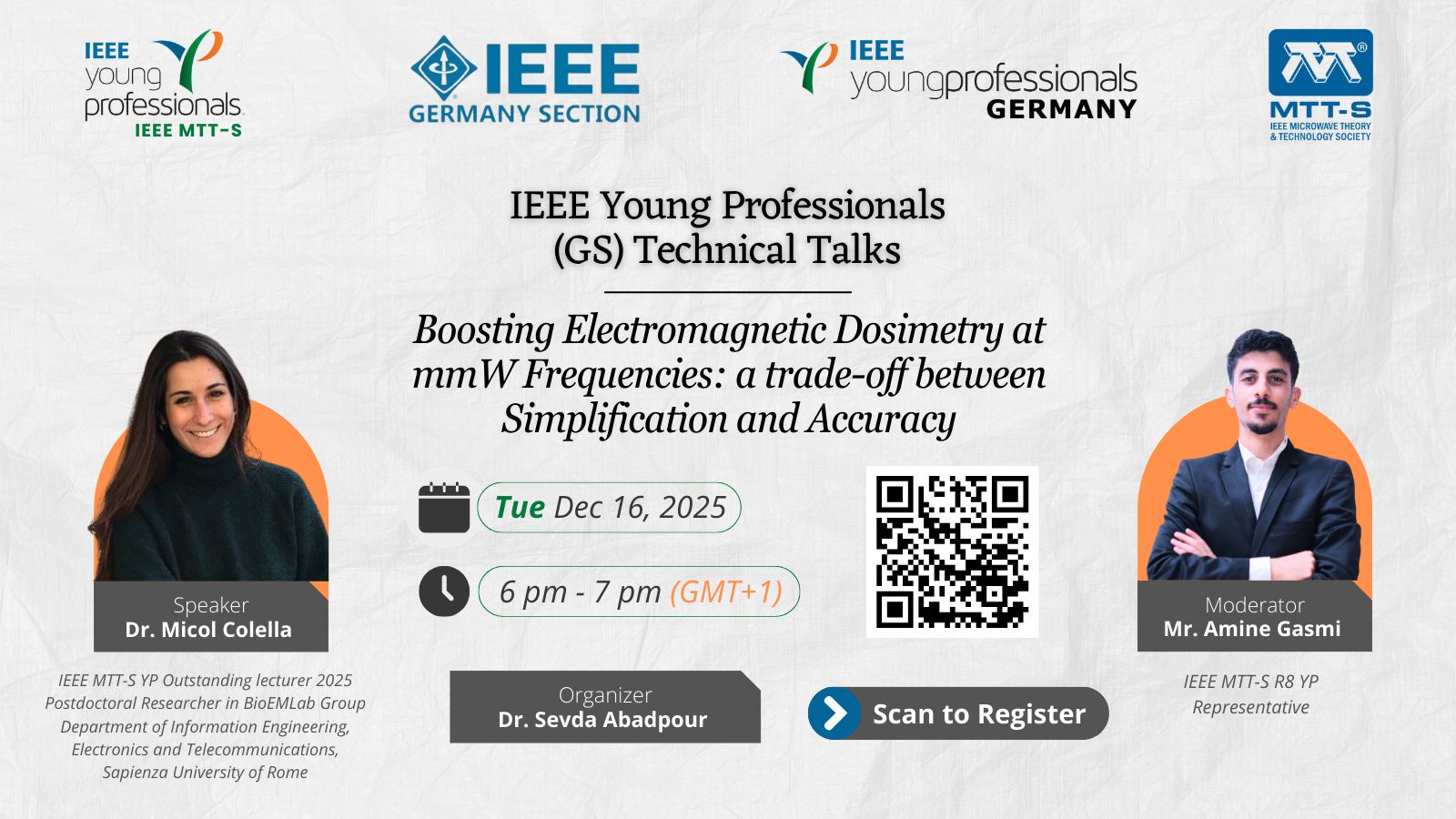
Date and Time
Location
Hosts
Registration
-
 Add Event to Calendar


Loading virtual attendance info...
- Starts 19 November 2025 12:30 PM UTC
- Ends 16 December 2025 04:02 PM UTC
- No Admission Charge
Speakers
Dr. Micol Colella
Boosting Electromagnetic Dosimetry at mmW Frequencies: a trade-off between Simplification and Accuracy
Abstract: In a fast-evolving world increasingly relying on smart environments that allow object-to-object and object-to-human communications, the deployment of wireless technologies is becoming of primary relevance. Novel wireless technologies, wearable devices, and in-body medical implants are transforming healthcare, communication, and personal monitoring. These advancements enable real-time health tracking and enhanced connectivity. Their spread has led to a saturation of the electromagnetic spectrum up to the higher bands of the microwave range (i.e., Ka-band) that are gaining increasing importance in everyday life. This poses critical challenges for the scientific community, particularly in understanding the potential health impacts of such exposure on populations. Numerical dosimetry plays a pivotal role in quantifying human body exposure to electromagnetic fields. However, at lower millimeter-wave (mmW) frequencies, there is limited consensus on the optimal strategies for modeling the human body. The skin, which is the primary tissue of interest at these frequencies, is anatomically complex, consisting of multiple layers—stratum corneum, viable epidermis, dermis, and hypodermis. Furthermore, depending on the wavelength, the curvature radius of the body may be considered negligible. For these reasons, simplified models are often preferred to virtual body models, as they reduce the computational complexity, while allowing for modelling the stratified structure of the skin. The proposed talk will compare existing numerical methodologies commonly used at mmW frequencies, highlighting the advantages and limitations of approaches like multilayer planar slabs and realistic anthropomorphic models. Through a comparison of electromagnetic exposure results obtained from Virtual Population (ViP) models and simplified multilayer slabs, the presentation will explore the observed differences between these methods. It will also discuss strategies for improving virtual human body models, making them more suitable for numerical dosimetry at critical mmW frequencies. This lecture aims to bridge gaps in dosimetric modeling and foster more accurate assessments of human exposure in complex exposure scenarios.
Biography:
Dr. Micol Colella ( IEEE MTT-S YP Outstanding lecturer 2025)
Postdoctoral Researcher in the Bioelectromagnetics Lab (Department of Information Engineering, Electronics and Telecommunications, Sapienza University of Rome, Italy).
She received her Master’s degree (cum laude) in Biomedical engineering and her PhD in Information and Communication Technology from Sapienza University of Rome in 2017 and in 2021, respectively. She’s currently holding a Postdoctoral research position in the BioEM Laboratory at the Department of Information Engineering, Electronics and Telecommunication, Sapienza University of Rome.
From 2017, she’s been involved in national and international projects in collaboration with industries and foreign research institutes. She is currently serving as Project Assistant for the EU-Funded Horizon 2020 Project RISEUP.
Her scientific interests include the computational modeling of electromagnetic fields interaction with the human body and dosimetry for clinical applications and safety purposes, with particular focus on 5G and WPT exposure systems, as well as neurostimulation and neuromodulation techniques. Dr. Colella is member of the BIOEM society, of the IEEE-MTT society and member of the URSI (International Union of Radioscience). She is Founder member of the Chapter Women In Radioscience (WIRS) Italy. In 2024 she was awarded with the Young Scientist Best Paper Award “Roberto Sorrentino”. In 2024 and 2022 she received the URSI AT-RASC 2024 and URSI GASS 2021 Young Scientist Awards respectively. In 2019 she was awarded with the Joseph Morissey Memorial Award for best platform presentation at the BioEM Joint Meeting
Address:Germany