

2026 IEEE Rochester NY JOINT CHAPTERS MEETING - FALL EDITION


Join the Rochester Section at one of our outstanding annual events.
The IEEE Rochester NY Section Joint Chapter Meeting is
Tue Oct 27th, 2026
Don’t miss this excellent opportunity to meet and network with people from all engineering disciplines and learn more about the activities of the different IEEE Society Chapters in the Rochester area.
The IEEE Rochester Joint Chapters Meeting (JCM) - Fall Edition features:
- 4 technical presentations from IEEE Society Chapters (in 2 parallel tracks),
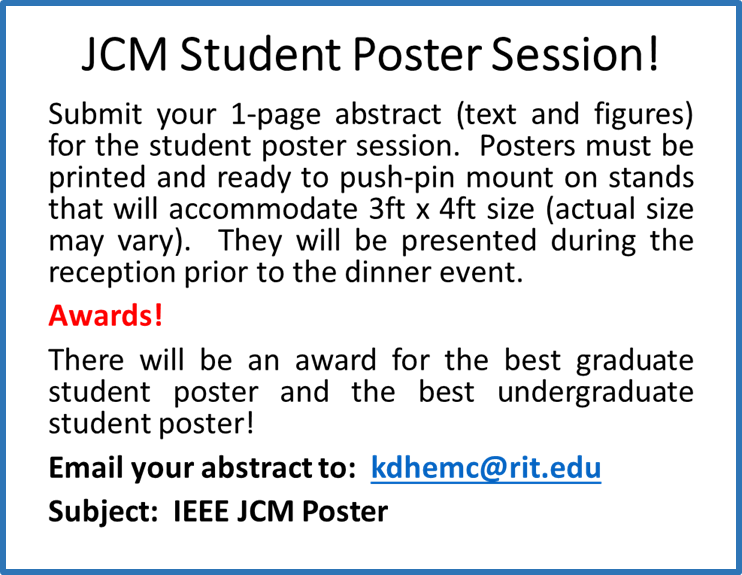
- Student poster session with select poster prizes!!!
- Professional networking featuring local and beyond industry representatives with coffee/tea, refreshments, fruits/crudités and a cash bar.
- An "ALL-AMERICAN BUFFET" dinner featuring chicken marsala, italian sausage, herb roasted potatoes and grilled vegetables, corn muffins and more, followed by cake and coffee/tea.
- Keynote presentation by Dr. David R. Holmes 3rd, Director - Biomedical Imaging Resource, Mayo Clinic Rochester MN
Registration is required.

Registration Pricing: BEFORE Monday, Oct 19, 11:59 PM
- $30 IEEE Member or IEEE Member's significant other
- $40 Non-member
- $10 IEEE Student Member
- $20 Non-IEEE Student Member
- $20 IEEE Life Member or IEEE Fellow
Registration Pricing AFTER Monday, Oct 19, 11:59 PM, add $5.
Please come back to this site for updates on the technical presentations and keynote lecture.
Date and Time
Location
Hosts
Registration
-
 Add Event to Calendar


- RIT Inn & Conference Center
- 5257 W Henrietta Rd, Henrietta, NY 14467
- Henrietta, New York
- United States 14467
- Click here for Map
- Starts 24 August 2026 04:00 AM UTC
- Ends 24 October 2026 03:59 AM UTC
- 0 in-person spaces left!
- Admission fee ?
Speakers
TEMS Speaker: Dr. Alex McMullen of Portico Health LLC
From Naive Engineer to Navigating Technology Translation
After starting a promising career in the medical device industry, Alex returned to academia to pursue his PhD believing that honing his technical engineering skills would help him follow his passion for translating cutting-edge technologies into real-world solutions. Along the way, he co-founded a startup around one of his inventions - with another potentially in the works - and learned an unexpected lesson: the technical engineering may be the easy part. In this talk, Alex will share some of the hard truths he is learning as he works to bring new technologies to market, including lessons in intellectual property, team building, and project management.
Biography:

Alex McMullen, PhD
Co-founder and Lead Engineer, Portico Health LLC
Dr. Alex McMullen is currently a postdoctoral researcher in Darren Lipomi’s lab in the Department of Chemical Engineering at the University of Rochester. He received his MS from the University of Rochester’s Center for Medical Technology & Innovation, followed by a PhD in Mark Buckley’s lab in the Department of Biomedical Engineering. Prior to graduate school, Alex gained nearly five years of experience in the medical device industry, primarily in quality engineering. Alex is also the co-founder and Lead Engineer of Portico Health LLC, an early-stage medical device startup developing new technologies to improve complex spine surgeries.
Email:
Address:Rochester, New York, United States, 14623
Photonics and Signal Processing Speaker: Dr. Mohammad-Ali Miri of Rochester Instittue of Technology
Computing with Light: From Optical Interference to Programmable Photonic Processors
Light can do more than carry information—it can also process it. As demand grows for faster and more energy-efficient computing, photonic systems offer new ways to perform mathematical operations using optical interference, propagation, and nonlinear interactions. This talk will introduce the physical principles behind computing with light and explain how integrated photonic circuits can be programmed to perform tasks such as matrix operations, signal processing, and optimization. Examples from our research will illustrate both the opportunities and the practical challenges, including precision, loss, programmability, and integration with electronics. The presentation is intended for engineers across disciplines and assumes no specialized background in photonics.
Biography:
Dr. Mohammad-Ali Miri, PhD
Associate Professor, Electrical and Microelectronics Engineering, RIT

Mohammad-Ali Miri is an Associate Professor in the Department of Electrical and Microelectronic Engineering at Rochester Institute of Technology, where he leads the Photonics and Information Laboratory. His research focuses on programmable photonic circuits, optical computing, and wave-based approaches to information processing and optimization. He received his Ph.D. in Optics from the University of Central Florida in 2014 and conducted postdoctoral research at the University of Texas at Austin. Before joining RIT, he served on the physics faculty at Queens College and the Graduate Center of the City University of New York.
Email:
Address:Rochester, New York, United States, 14623
MTT/AP Speaker: Dr. Younes Ra'di of Syracuse University
Dispersion Engineering and Time Modulation: From Fundamental Absorption Limits to Non-Foster Components and Antennas
Fundamental physical constraints limit the responses that can be realized with conventional passive, linear, time-invariant electromagnetic systems. These constraints appear in different forms—from the thickness–bandwidth tradeoff of absorbers, to the restrictions imposed by Foster’s reactance theorem on passive circuit components, to the bandwidth limitations of electrically small antennas. In this talk, I will discuss three directions we have been pursuing to address these constraints using dispersion engineering and time modulation.
The first part of the talk will focus on our recent work on dispersion-engineered, electrically thin absorbers. I will discuss how tailored dielectric and magnetic dispersion can be used to push absorber performance toward the fundamental Rozanov thickness–bandwidth limit, together with representative theoretical and experimental results.
The second part will focus on our recent work on passive non-Foster components. I will discuss how dispersion engineering can be used to realize effective negative inductance and negative capacitance over finite frequency ranges, together with our efforts toward compact and on-chip implementations.
The final part will focus on our recent work on direct antenna modulation (DAM). I will discuss how time modulation can be used to overcome the conventional bandwidth limitations of electrically small antennas, and how these concepts can be extended to antenna arrays and phased-array architectures.
Biography:

Younes Ra'di, PhD
Assistant Professor, Electrical Engineering and Computer Science, Syracuse University
Dr. Younes Ra'di is an Assistant Professor in the Department of Electrical Engineering and Computer Science at Syracuse University. His research is in applied electromagnetics and microwave engineering, with particular emphasis on engineered wave-matter interactions across RF, microwave, optical, and photonic systems. Prior to joining Syracuse, he was with the Advanced Science Research Center of The City University of New York, where he founded the RF and mm-Wave Facility in the Photonics Initiative. He previously held postdoctoral appointments at The University of Texas at Austin and the University of Michigan. He received his D.Sc. in Electrical Engineering, with distinction, from Aalto University, Finland. He serves as Associate Editor of IEEE Transactions on Antennas and Propagation and Advanced Electromagnetics, and is a Section Board Member of Photonics Journal. His recognitions include the URSI Young Scientist Award and the EuCAP 2025 Best Electromagnetics Paper Award.
Email:
Address:Syracuse, New York, United States
Signal Processing, Communications and MTT/AP Speaker: Dr. Aaron Roof of PDW - Vanteon
Techniques for Low Probability of Detection and Intercept (LPD/LPI) of RF Signals
Many modern applications in wireless communications require covert signaling to protect either the information and class of signal being transmitted, or the identity and location of the signal source. Minimizing the probability that an external receiver can detect or intercept the signal facilitates the protection of the information and source. This presentation discusses some techniques that are used to enable Low Probability of Detection (LPD) and Low Probability of Intercept (LPI) of RF signals. The techniques explored include spectrum spreading and agility, signal optimization and randomization over power and frequency, as well as use of spatial and temporal agility.
Biography:

Aaron Roof, PhD
General Manager, Vanteon - A PDW Business Unit
Aaron Roof is a Ph.D. graduate from the State University of New York at Buffalo (UB) in Electrical Engineering with a focus in Communications and Signal Processing. His area of research is in Software Defined Radio and Signal Classification for which he is a patent holder. Aaron is currently the General Manager of PDW’s Vanteon Business Unit. Prior to the PDW acquisition of Vanteon, Aaron was the Chief Technical Officer at Vanteon where he has worked since 2003. In addition to his Ph.D., he also received a M.S. degree from UB in 2008 and a B.S. degree in Electrical Engineering from Rochester Institute of Technology in 1994 where he also served for many years as an adjunct professor for Digital Signal Processing, RF Electronics, among other courses. He has 30+ years of experience working in the area of wireless communication systems and Software Defined Radio.
Email:
Address:Rocheser, New York, United States, 14623
EMBS Keynote: Dr. David R. Holmes III
Keynote - EMBS Distinguished Lecture: Healthcare AI at Scale: Mayo Clinic’s Strategy to Transform the Healthcare Sector
Mayo Clinic is committed to the guidance principle of “The needs of the patient come first.” Mayo Clinic invests in all aspects of healthcare, including innovative approaches to the clinical practice, novel healthcare research programs, advanced healthcare education, and optimized administrative workflows. Mayo Clinic has developed a comprehensive approach to integrating AI into the everyday operations of all aspects of Mayo Clinic.
This talk discusses Mayo’s strategy for AI in Healthcare with specific consideration to the underlying principles that drive Mayo to adopting these strategies with a goal to implement at scale. The talk will also highlight the principles guiding its deployment and the rigorous processes ensuring that every application serves the best interests of patients. The talk will also discuss how Mayo Clinic engages the healthcare sector with the goal of advancing AI to deliver smarter, more compassionate, and patient-centered care on a global scale.
Biography:

David R. Holmes III, Ph.D
Director, Biomedical Imaging Resource,
Mayo Clinic Graduate School of Biomedical Sciences
IEEE EMBS Distinguished Lecturer
Dr. David R. Holmes III is a Professor of Biomedical Engineering at Mayo Clinic. He studies the methods by which healthcare researchers analyze and interpret large data sets. Dr. Holmes conducts his research from the perspective that data drives decisions. In the case of personal health, individual and population-based data can inform health decisions, disease characterization and therapy planning. The use of Artificial Intelligence in healthcare has revolutionized biomedical research and clinical care, allowing for real-time mining the clinical and imaging data that exist within the electronic medical record yielding better-individualized strategies for patient health.
An experienced educator, Dr. Holmes has mentored students across various levels, many of whom have received prestigious fellowships and hold leadership positions in academia and industry. Dr. Holmes is also the Program Director for the Mayo Graduate School Masters of Artificial Intelligence in Healthcare. This unique educational program trains future clinical practitioners, biomedical scientists, and healthcare leaders to adopt an integrated approach to improving human health which leverages Artificial Intelligence principles and tools in clinical care, discovery science, and healthcare decision making.
Beyond academia, Dr. Holmes actively contributes to the IEEE Engineering in Medicine and Biology Society, serving as Chair of the IEEE Southern Minnesota Section EMBS Chapter. He leads community outreach initiatives, including the IEEE Science Movie Night, engaging students in biomedical engineering. His dedication to research, education, and outreach reinforces his impact on healthcare innovation and mentorship.
Email:
Address:Rochester, Minnesota, United States, 55901
Agenda
IEEE Rochester Section Joint Chapters Meeting Agenda
4:30 – 7:30 PM Registration
5:00 – 5:40 PM Chapter Technical Presentations - Session 1
- Salon A: Dr. Alex McMullen (Portico Health LLC): From Naive Engineer to Navigation Technology Translation
- Salon B: Dr. Aaron Roof (PDW - Vanteon): Techniques for Low Probability of Detection and Intercept (LPD/LPI) of RF Signals
5:40 – 6:20 PM Chapter Technical Presentations - Session 2
- Salon A: Dr. Mohammad-Ali Miri (RIT): How Analog Computing Solves Signal Processing Challenges Faster
- Salon B: Dr. Younes Ra'di (Syracuse University): Dispersion Engineering and Time Modulation: From Fundamental Absorption Limits to Non-Foster Components and Antennas
6:20 – 7:30 PM Student Poster Session and Professional Networking - Visit Information and Sponsor Tables
7:30 – 8:15 PM Buffet Dinner
8:15 - 9:15 PM Keynote Presentation:
Dr David R. Holmes 3rd (IEEE EMBS Distinguished Lecturer, Director, Biomedical Imaging Resource, Mayo Clinic Graduate School of Biomedical Sciences, Rochester MN): Engineering Healthcare: Case studies in the application of medical imaging and biomedical engineering
9:30 PM - End
This event is open to the general public.