

Oregon Nano Chapter - Multi-scale Modeling of Memory Devices, Nov 17


IEEE Oregon Nanotechnology Chapter presents
Topic: Multi-scale Modeling of Memory Devices
Speaker: M. P. (Anant) Anantram, University of Washington, Seattle
Date: November 17, 2022 Time: 6:00-8:00 pm
Location:PCC Willow Creek Center, Room 320 241 SW Edgeway Drive (near SW 185th and Baseline Road) Beaverton, OR 97006 (seminar room sponsored by the PSU ECE department)
Directions: http://www.pcc.edu/about/locations/willow-creek/
Also avaible via Zoom.
Date and Time
Location
Hosts
Registration
-
 Add Event to Calendar


Loading virtual attendance info...
- PCC Willow Creek Center
- 241 SW Edgeway Drive
- Beaverton, Oregon
- United States 97006
- Room Number: 320
- Starts 04 November 2022 10:45 AM UTC
- Ends 17 November 2022 08:00 PM UTC
- No Admission Charge
Speakers
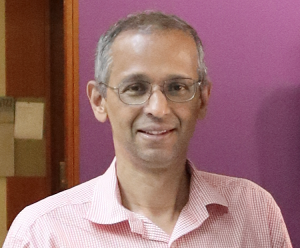 M. P. (Anant) Anantram of University of Washington, Seattle
Multi-scale Modeling of Memory Devices
Quantum mechanical methods play an increasingly important role in modeling emerging memory devices. We will discuss methods to model three classes of memory devices, phase change, resistive, and DNA X memory. While prototype phase change and resistive devices have been demonstrated, the DNA X memory is still in an early concept stage but promises unprecedented increases in 3D density.
Ab initio methods are used to determine the formation energies and diffusion barriers for vacancy-interstitial pairs and atom reorganization in memory devices. To model filaments in resistive memory devices, ab initio calculations should be coupled with the Kinetic Monte Carlo simulations and the solution to the heat equation from which a temperature profile in the device is obtained. In devices with a nanoscale channel length, electrons are transmitted through less than twenty atomic layers, and this creates challenges for modeling by requiring attention to the quantum nature of electron flow. We discuss the failure of purely quantum models at these nanoscale dimensions and the need for new methods to account for decoherence, quasi-ballistic transport and the role of atomic orbitals in determining device characteristics.
Biography:
M. P. Anantram is a professor of Electrical and Computer Engineering at the University of Washington, Seattle. His prior appointments included the University of Waterloo and the Center for Nanotechnology at the NASA Ames Research Center. His group is currently focused on understanding the electronic transport properties of bionano structures and emerging memory devices, along with finding efficient new methods to model these structures. He obtained his BSc (Applied Science) from PSG College of Technology, MSc (Physics) from Pune University and PhD (Engineering) from Purdue University.
Address:Seattle, Washington, United States
Agenda
6:00 pm Welcome/Pizza
6:30 pm Lecture
8:00 pm End