

Deep Learning for mmWave and THz Beamforming Applications


The millimeter-wave (mm-Wave) massive MIMO communications/radar employ hybrid analog-digital beamforming architectures to reduce the cost-power-size-hardware overheads. Lately, there is also a gradual push to move from the millimeter-wave (mmWave) to Terahertz (THz) frequencies for short-range communications and radar applications to exploit very wide THz bandwidths.
Date and Time
Location
Hosts
Registration
-
 Add Event to Calendar


Loading virtual attendance info...
- University of South Florida
- 4220 E. Fowler Ave.
- Tampa, Florida
- United States 33620
- Building: Engineering Building - ENB
- Room Number: Room 109
- Starts 09 May 2023 04:00 PM UTC
- Ends 14 July 2023 04:00 PM UTC
- No Admission Charge
Speakers
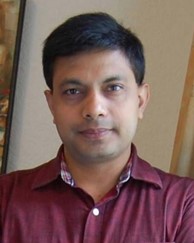 Dr. Kumar Vijay Mishra of US Army Research Laboratory
Deep Learning for mmWave and THz Beamforming Applications
The millimeter-wave (mm-Wave) massive MIMO communications/radar employ hybrid analog-digital beamforming architectures to reduce the cost-power-size-hardware overheads. Lately, there is also a gradual push to move from the millimeter-wave (mmWave) to Terahertz (THz) frequencies for short-range communications and radar applications to exploit very wide THz bandwidths. At THz, ultra massive MIMO is an enabling technology to exploit even wider bandwidth while employing thousands of antennas. The design of the hybrid beamforming techniques requires the solution to difficult nonconvex optimization problems that involve a common performance metric as a cost function and several constraints related to the employed communication regime and the adopted architecture of the hybrid system(s). There is no standard methodology for solving such problems and usually, the derivation of an efficient solution is a very challenging task. Since optimization-based approaches suffer from high computational complexity and their performance strongly relies on the perfect channel condition, we introduce deep learning (DL) techniques that provide robust performance while designing a hybrid beamformer. In this lecture, the audience will learn about applying DL to various aspects of hybrid beamforming including channel estimation, antenna selection, wideband beamforming, and spatial modulation. In addition, we will examine these concepts in the context of joint radar-communications architectures.
Biography:
Dr. Kumar Vijay Mishra (IEEE S’08-M’15-SM’18) obtained a Ph.D. in electrical engineering and M.S. in mathematics from The University of Iowa in 2015, and M.S. in electrical engineering from Colorado State University in 2012, while working on NASA’s Global Precipitation Mission Ground Validation (GPM-GV) weather radars. He received his B. Tech. summa cum laude (Gold Medal, Honors) in electronics and communication engineering from the National Institute of Technology, Hamirpur (NITH), India in 2003. He is currently Senior Fellow at the United States Army Research Laboratory (ARL), Adelphi; Technical Adviser to Singapore-based automotive radar start-up Hertzwell and Boston-based imaging radar startup Aura Intelligent Systems; and honorary Research Fellow at SnT - Interdisciplinary Centre for Security, Reliability and Trust, University of Luxembourg. He is the recipient of U. S. National Academies Harry Diamond Distinguished Fellowship (2018-2021), Royal Meteorological Society Quarterly Journal Editor's Prize (2017), Viterbi Postdoctoral Fellowship (2015, 2016), Lady Davis Postdoctoral Fellowship (2017), DRDO LRDE Scientist of the Year Award (2006), and NITH Director’s Gold Medal (2003). He is Vice-Chair (2021-present) of the newly constituted IEEE Synthetic Aperture Standards Committee of the IEEE Signal Processing Society. Since 2020, he has been Associate Editor of IEEE Transactions on Aerospace and Electronic Systems for which he was awarded Outstanding Associate Editor recognition in 2021. He has been elected Vice Chair (2021-2023) and Chair-designate (2023-2026) of International Union of Radio Science (URSI) Commission C. He is the lead/corresponding co-editor of three upcoming books on radar: Signal Processing for Joint Radar-Communications (Wiley-IEEE Press), Next-Generation Cognitive Radar Systems (IET Press Radar, Electromagnetics & Signal Processing Technologies Series), and Advances in Weather Radar Volumes 1, 2 & 3 (IET Press Radar, Electromagnetics & Signal Processing Technologies Series). He is also the founding member of IEEE Communications Society Integrated Sensing and Communications Emerging Technologies Initiative (ISAC-ETI). He has won many Best Paper prizes, including IET Premium Award (2021). His research interests include radar systems, signal processing, remote sensing, and electromagnetics.
Email:
Address:US Army Research Laboratory, , Adelphi, Maryland, United States, 20783
Agenda
Virtual and In Person - Link and Venue will be provided
6:00 pm - 7:00 pm Lecture
7:00 pm - 7:30 pm Questions & Answers