

L1 ADAPTIVE CONTROL AND ITS TRANSITION TO PRACTICE


Over the last two decades there has been significant progress in autonomous systems developments and AI applications in aerospace. However, these systems, including learning components, must have formal assurance of their behavior before they can be safely deployed in the real-world. Our research provides an assurance framework for learning-enabled systems as a foundation for physical AI for flight. A typical architecture in these systems involves layers for perception, planning and control, wherein each of these layers uses different tools and metrics for assessing robustness and performance. For example, the planners -- that use vision-based sensors to update the navigation and motion planning -- operate largely relying on distributionally robust stochastic optimal control, whereas the low-level controller can be a deterministic controller with its conventional gain and phase (time-delay) margin. We present a new analysis framework for addressing this ontology challenge inherent to autonomous systems. We derive distributional robustness guarantees for deterministic L1 adaptive controllers that can be used by any stochastic planner without facing a language barrier. The combined planner-controller framework can serve as foundation for development of certificates for V&V of learning-enabled systems and -- with that -- ensure a rigorous physical AI development for flight. An overview of different projects at our lab that build upon this framework will be demonstrated to show different applications. In particular, the presentation will cover the flight tests of AirSTAR from NASA’s 2007-2010 Aviation Safety program, Learjet flights from Edwards AFB from 2015-2018, including a brief episode of Lockheed Martin’s VISTA X-62 flight test achieving TRL-6 in 3g flight condition, and many others.
Date and Time
Location
Hosts
Registration
-
 Add Event to Calendar


Loading virtual attendance info...
- Starts 04 September 2026 04:00 AM UTC
- Ends 20 October 2026 08:00 PM UTC
- No Admission Charge
Speakers
Dr. Hovakimyan
L1 ADAPTIVE CONTROL AND ITS TRANSITION TO PRACTICE
Over the last two decades there has been significant progress in autonomous systems developments and AI applications in aerospace. However, these systems, including learning components, must have formal assurance of their behavior before they can be safely deployed in the real-world. Our research provides an assurance framework for learning-enabled systems as a foundation for physical AI for flight. A typical architecture in these systems involves layers for perception, planning and control, wherein each of these layers uses different tools and metrics for assessing robustness and performance. For example, the planners -- that use vision-based sensors to update the navigation and motion planning -- operate largely relying on distributionally robust stochastic optimal control, whereas the low-level controller can be a deterministic controller with its conventional gain and phase (time-delay) margin. We present a new analysis framework for addressing this ontology challenge inherent to autonomous systems. We derive distributional robustness guarantees for deterministic L1 adaptive controllers that can be used by any stochastic planner without facing a language barrier. The combined planner-controller framework can serve as foundation for development of certificates for V&V of learning-enabled systems and -- with that -- ensure a rigorous physical AI development for flight. An overview of different projects at our lab that build upon this framework will be demonstrated to show different applications. In particular, the presentation will cover the flight tests of AirSTAR from NASA’s 2007-2010 Aviation Safety program, Learjet flights from Edwards AFB from 2015-2018, including a brief episode of Lockheed Martin’s VISTA X-62 flight test achieving TRL-6 in 3g flight condition, and many others.
Biography:
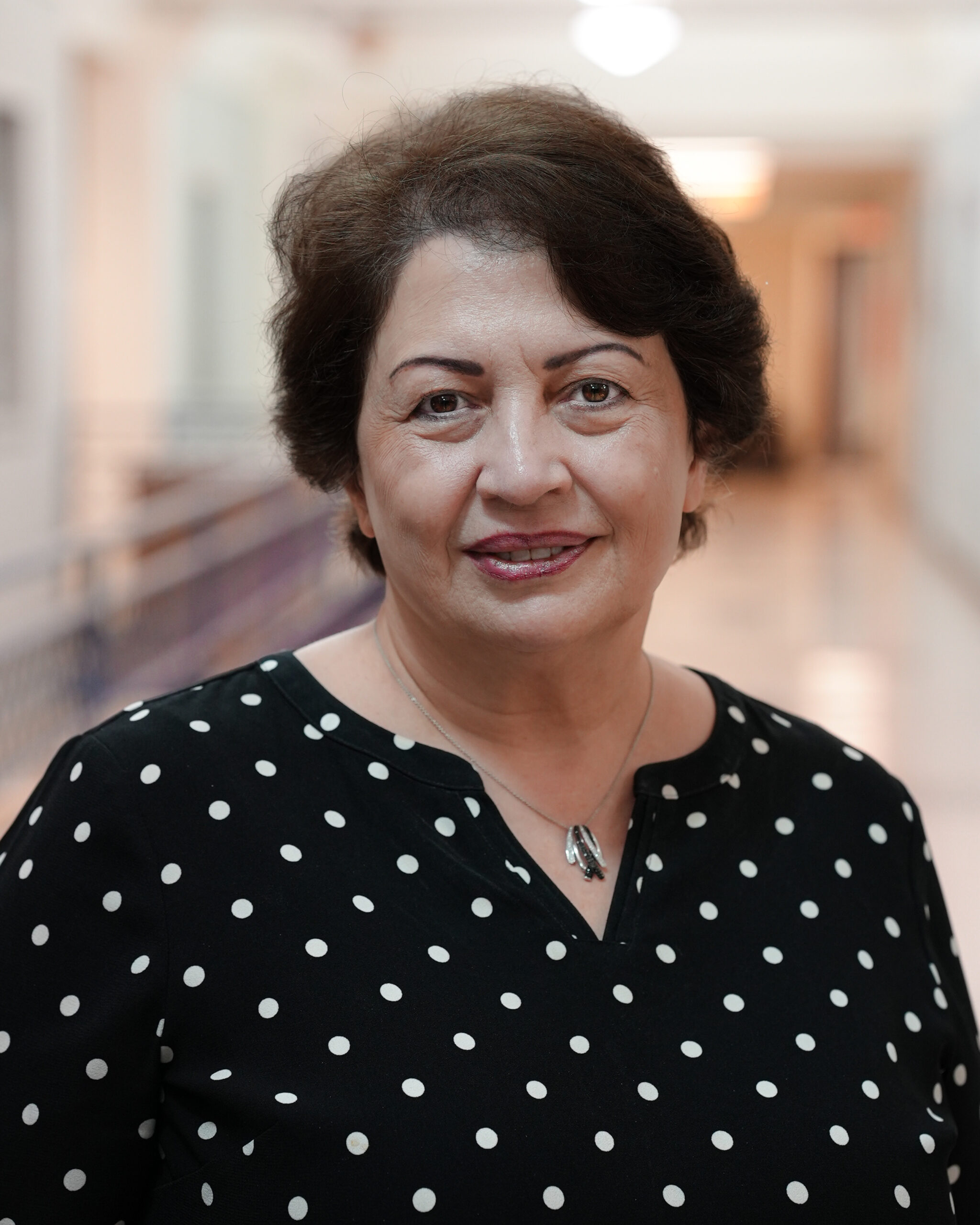
Naira Hovakimyan received her MS degree in Applied Mathematics from Yerevan State University in Armenia. She got her Ph.D. in Physics and Mathematics from the Institute of Applied Mathematics of Russian Academy of Sciences in Moscow. She is currently W. Grafton and Lillian B. Wilkins Professor of Mechanical Science and Engineering and the Director of AVIATE Center of UIUC. She has co-authored two books, thirteen patents and more than 500 refereed publications. She is the 2011 recipient of AIAA Mechanics and Control of Flight Award, the 2015 recipient of SWE Achievement Award, the 2017 recipient of IEEE CSS Award for Technical Excellence in Aerospace Controls, and the 2019 recipient of AIAA Pendray Aerospace Literature Award. In 2014 she was awarded the Humboldt prize for her lifetime achievements. She is IEEE CSS Distinguished Lecturer for 2026-2028. She is Fellow of AIAA, IEEE, ASME, IFAC, and senior member of NAI. She is cofounder and chief scientist of Intelinair, and cofounder and CEO of Kestrel Robotics. Her work was featured in the New York Times, on Fox TV and CNBC.
Email:
Address:MECHANICAL SCIENCE AND ENGINEERING, UNIVERSITY OF ILLINOIS AT URBANA-CHAMPAIGN, 105 S Mathews Ave, Urbana, Illinois, United States, 61801